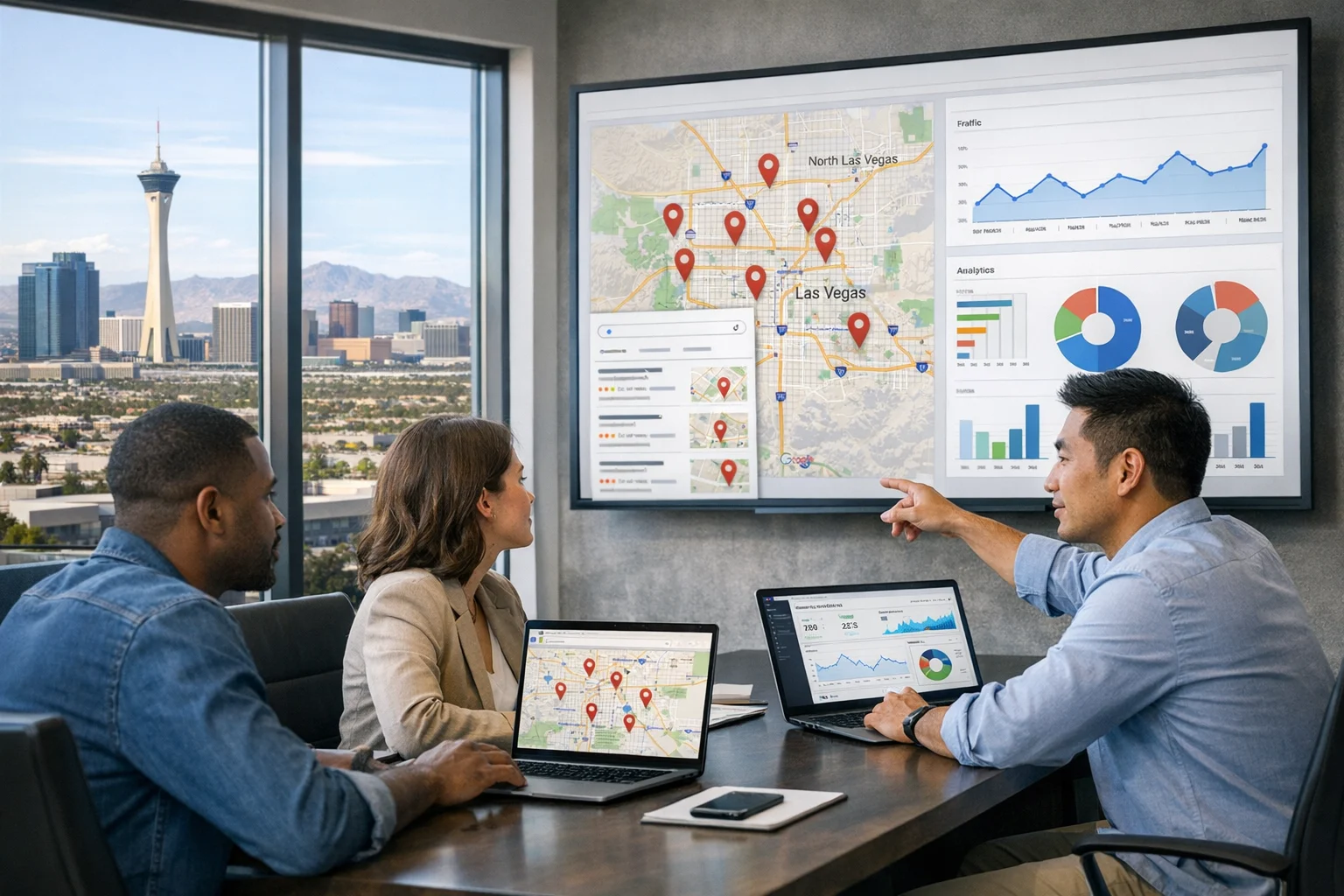
Las Vegas is one of the most competitive local search markets in the country. That applies to restaurants on busy corridors, law firms, wellness brands, home service companies, medical practices, contractors, and e-commerce brands trying to capture local demand. It also applies to North Las Vegas businesses serving fast-growing neighborhoods, industrial clients, and logistics routes that depend on qualified local traffic.
If your company wants more calls, form fills, booked appointments, and walk-in traffic, you cannot rely on one channel. You need visibility in Google Maps and in traditional organic results. Those two areas work together. When a company shows up in the map pack and also earns strong organic rankings beneath it, trust increases, clicks increase, and lead volume usually follows.
At SiteLiftMedia, we see this all the time. Many businesses come to us after spending money on a website that looks decent but does not rank, or after hiring a Las Vegas SEO agency that reports impressions but cannot connect search traffic to revenue. The companies that gain ground usually do a few things well. They build a stronger local foundation, improve technical SEO, publish pages that match buying intent, and treat conversion performance as part of SEO, not a separate project.
Here is what helps local companies compete in Las Vegas SEO right now.
Why Google Maps and organic search need to be treated as one strategy
Business owners often ask whether they should focus on map pack rankings or organic rankings first. In Las Vegas, the better answer is both. Google Maps captures high-intent searches such as plumber near me, urgent care Las Vegas, patio contractor North Las Vegas, or estate planning lawyer Las Vegas. Organic search gives you more room to rank for detailed service terms, neighborhood terms, and informational queries that influence buyers before they call.
When your Google Business Profile is optimized, your website supports the same location and service signals, and your review profile is active, Google gets a much clearer understanding of your business. That improves local relevance. It also helps users trust what they see. A listing with strong reviews and a website that loads quickly and answers the searcher’s question is far more likely to convert than a listing with weak content and a dated site.
This matters even more during seasonal surges. Las Vegas businesses often see demand spikes during summer campaigns, tourism season, and event-heavy periods. If your local SEO Las Vegas strategy is only half built when competitors are already visible in both placements, you can lose market share quickly.
Start with Google Business Profile optimization that matches how people actually search
For many local companies, Google Business Profile optimization is still the fastest path to better visibility. Yet a surprising number of listings are incomplete, inconsistent, or poorly aligned with real search demand.
Your profile should include the correct primary category, relevant secondary categories, accurate business hours, service areas where appropriate, a keyword-aligned business description, strong photos, and updated service information. If you serve multiple parts of the valley, your listing and website should reflect that in a clean, credible way. That is especially important for contractors, electricians, HVAC companies, med spas, and mobile service providers working throughout Las Vegas and North Las Vegas.
For example, a contractor serving Aliante, Tule Springs, Centennial Hills, and industrial North Las Vegas should not leave location relevance up to chance. Service pages, reviews, and listing details should reinforce that geographic footprint. Logistics companies and B2B service providers in North Las Vegas can also benefit from clearly communicating the industries they serve, such as warehousing, distribution, transportation, and fleet support.
Review generation also has a direct impact on map pack rankings and click-through rates. The best review strategies are consistent and operational. Ask after a completed job, after a successful appointment, or after a positive client milestone. Do not wait until someone on the team happens to remember. Build it into your workflow. Then respond to reviews in a way that builds trust and adds location context without sounding canned.
If you want a deeper look at how listings influence local visibility, this guide on why Google Business Profile matters for Las Vegas SEO is worth reviewing.
What strong local listings usually include
- Accurate business data across your profile, website, and major directories
- Real service descriptions written around customer intent, not keyword stuffing
- Fresh photos of your team, location, work, products, and vehicles
- Consistent review activity with thoughtful responses
- Relevant categories that match what you actually sell
- Clear landing pages on your site that support the listing
Build service pages and location pages that deserve to rank
One of the biggest gaps we see from businesses comparing a Las Vegas web designer or SEO company Las Vegas is weak page structure. They may have a homepage, a contact page, and a short services page, but nothing substantial enough to rank for real local queries.
If you want stronger organic visibility, your site needs dedicated pages for core services and, where appropriate, nearby markets. That does not mean spinning up thin city pages with a few swapped place names. Google is much better at detecting shallow local content than it used to be. Pages need to show experience, specificity, and commercial usefulness.
A good local service page should explain what you offer, who it is for, common problems, your process, trust signals, FAQs, and why a buyer should contact you now. A good location page should tie those services to the area with real context. For North Las Vegas businesses, that may include references to residential growth, commercial development, industrial demand, or the needs of companies operating around major transit corridors.
This is where many firms miss easy wins. They talk about themselves instead of the customer’s situation. A roofing company should address heat exposure, storm wear, insurance questions, and roof lifespan in the Las Vegas climate. A med spa should cover treatment goals, consultation steps, and next actions. A logistics provider should speak directly to delivery timelines, route efficiency, warehouse support, and service coverage across Southern Nevada.
That content has to be supported by solid Las Vegas web design. A beautiful site that hides services, forces users through clunky navigation, or buries contact options will struggle no matter how much traffic it gets. The same is true for web design Las Vegas projects that prioritize visuals but ignore search intent and conversion flow.
Pages that tend to perform best
- Primary service pages for high-intent offers
- Location-specific pages for true service areas like Las Vegas and North Las Vegas
- Industry pages for B2B companies serving niches such as logistics, construction, or healthcare
- FAQ-rich pages that answer pre-sale concerns and support FAQ schema
- Conversion-focused website sections with clear forms, phone calls, and trust elements
Technical SEO is often the reason good businesses stay invisible
Many local companies do not have a ranking problem first. They have a technical SEO problem. Their pages load slowly, mobile usability is weak, internal linking is poor, and indexing signals are messy. Google can still crawl the site, but it does not get enough confidence to rank it well.
Las Vegas users are impatient. They are searching from mobile devices, often comparing several providers quickly. If your site lags, shifts around while loading, or forces users to pinch and zoom, you are losing both rankings and leads. This is where fast hosting, image optimization, caching, code cleanup, and streamlined templates matter.
Technical SEO should also cover crawlability, site architecture, metadata, canonical handling, redirect management, XML sitemaps, structured internal links, and schema implementation. For local businesses, structured data can reinforce organization details, service information, FAQs, reviews where appropriate, and location signals.
Site performance is also tied to trust. If you run outdated plugins, neglect security patches, or host on a weak server, you create risk for both users and rankings. Strong Las Vegas website maintenance helps keep search gains from slipping. In some cases, businesses also need cybersecurity services and server hardening, especially if they handle customer data, medical inquiries, or e-commerce transactions.
That is one reason a serious Las Vegas SEO firm should not separate search strategy from platform health. Rankings are easier to grow when the site is stable, fast, and secure.
Structured data and AI SEO are becoming part of local visibility
Search is changing. Google still rewards classic local SEO work, but it is also using more entity-based understanding, AI-generated summaries, and answer extraction from trusted pages. That is why Las Vegas AI SEO is not just a buzz phrase anymore. It is becoming a practical extension of technical SEO and content strategy.
For local companies, AI SEO Las Vegas work often includes improving page clarity, tightening topical relationships, using structured data, and publishing content that answers real purchase questions in a direct, credible way. This can help your business appear in richer search features and increase the chance that your content is cited or paraphrased in AI-driven search experiences.
FAQ schema is especially useful when your page already includes concise answers to high-value customer questions. Service schema, organization schema, and local business schema can also strengthen how search engines interpret your site. None of this replaces core SEO. It supports it.
If you want to understand the connection between modern markup and visibility, SiteLiftMedia has a helpful article on AI SEO and structured data for Las Vegas search.
If your competitors are still publishing generic pages while your site is technically clean, clearly structured, and aligned with AI-friendly content patterns, that advantage can build over time.
Local authority still matters, but it needs to be earned the right way
Backlinks, mentions, and local citations still matter in Las Vegas SEO, but quality matters far more than volume. A few relevant local links can outperform a pile of junk directory placements.
For service businesses, authority often grows from real community connections. Sponsoring local events, joining industry associations, participating in chamber groups, being featured by local publications, supporting school programs, or partnering with complementary businesses can all create legitimate visibility signals. North Las Vegas businesses have strong opportunities here because community ties are often more tangible and local growth stories are easier to connect to actual service demand.
Review language also acts like a form of authority. When customers naturally mention your services, neighborhood, professionalism, response time, or project type, those details support relevance. You should never script reviews too tightly, but you can make the ask easier and time it well.
Citations still have a role, especially for businesses with location consistency issues. Just do not confuse citation cleanup with a complete local SEO strategy. It is a baseline task, not the entire campaign.
Your website has to convert the traffic SEO brings in
Traffic without conversion is expensive, even when the clicks are free. This is where Las Vegas website design and SEO should work together. If a user finds you through Google Maps or organic search, lands on your page, and does not immediately understand what you do, where you work, and how to contact you, the lead is probably gone.
A conversion-focused website usually has a few things in common. It loads fast. It has clear calls to action. It answers objections early. It uses strong page hierarchy. Contact methods are easy to find. Trust signals are visible without making users hunt for them. On mobile, forms are simple and phone links are obvious.
For local service providers, before and after galleries, service area content, financing information, scheduling tools, and review highlights can improve lead generation. For professional firms, stronger intake forms, attorney or provider profiles, and cleaner credibility cues often move the needle. For restaurants and hospitality brands, menus, reservations, hours, and local intent pages need to be friction-free.
This is why businesses comparing a Las Vegas web designer should ask whether that provider understands search intent, local landing page structure, analytics, and conversion behavior. Custom web design is valuable, but only when it supports the job the website is supposed to do.
Use SEO and PPC together when competition gets aggressive
In highly competitive categories, SEO alone can take time. That does not mean you sit still while waiting for rankings to grow. Smart businesses use paid campaigns to support organic strategy, test messaging, and capture demand that is too valuable to ignore.
Summer campaigns are a good example. HVAC companies, pool services, med spas, moving companies, and tourism-adjacent brands often need immediate lead flow while organic momentum builds. Well-targeted PPC landing pages can generate short-term demand and reveal which offers, headlines, and service angles convert best. Those insights can then improve your SEO pages.
There is also a branding advantage. When users see your business in ads, in the map pack, and in organic results, perceived legitimacy rises. That is especially useful for newer brands or established companies entering a tougher part of the market.
SiteLiftMedia often recommends a blended approach for companies preparing for stronger competition or launching new service lines. If that sounds relevant, this article on why Las Vegas businesses should combine SEO and PPC explains the logic well.
What to look for in a Las Vegas SEO agency or web design partner
If you are comparing a Las Vegas SEO agency, Las Vegas SEO firm, digital marketing agency Las Vegas provider, or a Las Vegas web design team, ask tougher questions than most buyers do.
Do they understand the Las Vegas market beyond the Strip? Can they speak intelligently about North Las Vegas growth, local service competition, and the difference between ranking a restaurant versus a contractor or logistics brand? Do they show you how map pack rankings, organic traffic, calls, forms, and booked revenue connect? Can they improve technical SEO and the website itself, or do they only offer content and reports?
You should also ask who handles implementation. Many agencies are strong at selling but weak at execution. If your site needs custom web design, faster hosting, structured data, content rewrites, or Las Vegas website maintenance, you need a partner that can actually do the work without sending everything through layers of subcontractors.
Questions worth asking before you hire
- How do you improve both Google Maps visibility and organic rankings?
- What technical SEO issues will you audit first?
- How do you measure lead quality, not just traffic?
- Can you support web design Las Vegas improvements if the site is the bottleneck?
- How do you use structured data and Las Vegas AI SEO in local campaigns?
- What is your plan for reviews, local content, and conversion improvements?
The best partner will give you clear answers, realistic expectations, and a plan that reflects how your actual customers search.
If your company wants stronger map pack rankings, better organic visibility, and a website that turns local traffic into real leads, SiteLiftMedia can help you identify the gaps and prioritize what to fix first. Reach out for a practical review of your current local SEO, website performance, and search opportunities in Las Vegas and North Las Vegas.
Local Focus: Las Vegas Search Visibility
SiteLiftMedia works with businesses that want stronger visibility across the Las Vegas valley. The map below highlights the local market context for this article and the kind of location based search intent that matters when people compare a Las Vegas web designer, Las Vegas SEO agency, or local SEO firm.
Frequently Asked Questions
How long does Las Vegas SEO take to improve Google Maps and organic rankings?
Most businesses see early movement in 60 to 90 days, but stronger gains usually take several months. Competition, website quality, review volume, and technical issues all affect timing.
What matters more for local SEO in Las Vegas, Google Business Profile or the website?
Both matter. Your Google Business Profile helps with Maps visibility, while your website supports organic rankings, conversion performance, and trust. The best results come when both are aligned.
Do North Las Vegas businesses need separate location pages?
If North Las Vegas is a meaningful service area or business location, a dedicated page can help. It needs unique, useful content that reflects the area and the services you actually provide there.
How does Las Vegas AI SEO fit into local search strategy?
AI SEO helps structure content so search engines can better understand services, locations, and answers to customer questions. It often includes cleaner content architecture, structured data, and pages designed for modern search features.
What should I look for in a Las Vegas SEO agency or web designer?
Look for a team that can handle technical SEO, content strategy, conversion improvements, and local market targeting. They should connect rankings to leads and be able to improve the website itself when needed.
Can SEO help if I already run PPC landing pages?
Yes. SEO and PPC work well together. Paid campaigns can capture immediate demand and test offers, while SEO builds long term visibility and lowers dependence on ad spend over time.
Photo Gallery