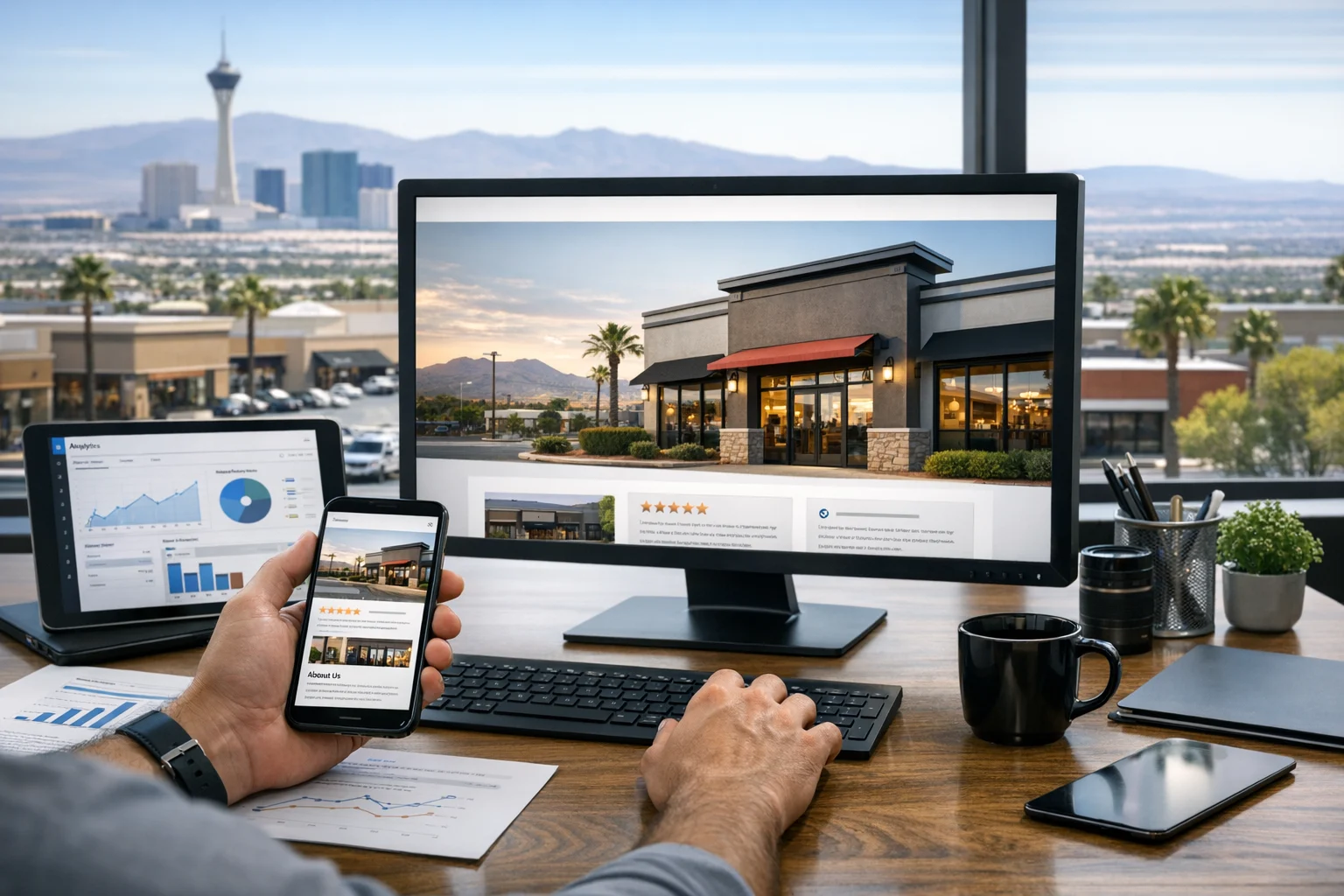
Most Las Vegas service businesses do not have a traffic problem. They have a page problem.
They invest in Google Ads, local SEO Las Vegas campaigns, Google Business Profile optimization, content updates, and sometimes even a full website redesign. Then the click comes in, the visitor lands on a weak page, and the opportunity slips away. That is why landing pages matter so much. They sit where search visibility, ad spend, trust, and conversion all meet.
At SiteLiftMedia, we see this across industries in Las Vegas, especially among growing brands in areas like Centennial Hills. Contractors, medical offices, family-focused brands, law firms, home service companies, and wellness providers often have decent-looking websites that still underperform because their key pages are too generic, too broad, too slow, or too disconnected from what people actually searched.
A landing page is not just a design asset. It is a sales page, a search asset, and a lead generation tool. If you are comparing a Las Vegas web designer, a Las Vegas SEO agency, a Las Vegas SEO firm, or an AI SEO Las Vegas partner, this is one of the first things to examine. Strong landing pages can lower cost per lead in paid campaigns, support map pack visibility in organic search, and improve lead quality at the same time.
That matters even more in a competitive local market like Las Vegas, where intent shifts by neighborhood, service type, urgency, and device. Someone in Centennial Hills searching for an emergency plumber is not behaving like someone in Summerlin researching cosmetic dentistry or someone downtown comparing business attorneys. Better pages reflect that reality.
Why the average service page underperforms in Las Vegas
A lot of service websites in Las Vegas were built with a basic structure in mind. Home, about, services, contact. That can work as a starting point, but it rarely works as a growth system.
When a user searches for a specific service, Google wants to send them to the most relevant page. If your website only has one broad services page and a few short blurbs, you make it harder for your business to rank organically and harder for paid traffic to convert. The page is trying to speak to everyone, which means it speaks clearly to no one.
Here are some of the most common problems we see:
- The headline is vague and does not match search intent
- The page focuses on the company instead of the customer problem
- There is little local relevance for Las Vegas neighborhoods or service areas
- The call to action is buried or too soft
- The page loads slowly or breaks on mobile
- There are no trust elements such as reviews, licensing, certifications, or process details
- Forms ask too much or too little, which hurts lead quality
- The page is not built with technical SEO, structured data, or clear internal linking
That combination hurts both Las Vegas SEO and PPC landing pages. Organic users do not find enough topical depth or geographic relevance. Paid users do not see enough confidence signals to take action.
If your business serves northwest Las Vegas neighborhoods, family communities, or high-trust categories like healthcare and home services, the gap becomes even more obvious. A medical office in Centennial Hills needs a different message than a strip contractor serving commercial jobs across the valley. The page has to reflect the service, the urgency, the location, and the next step.
Landing pages are where SEO and PPC finally work together
Many business owners separate SEO and paid ads into different buckets. One is supposed to drive rankings. The other is supposed to drive leads fast. In practice, both channels depend heavily on landing page quality.
A good SEO page helps you rank for high-intent terms such as dentist in Centennial Hills, HVAC repair Las Vegas, or family law attorney Las Vegas. A good PPC page helps convert the clicks you buy for those same terms. When the page is aligned with the keyword, audience, and offer, both channels improve.
This is one reason the best digital marketing agency Las Vegas teams do not treat design, content, SEO, and paid media as separate projects. They build around the page experience. SiteLiftMedia does this often for local service brands that are tired of getting traffic without enough booked calls, form fills, or scheduled appointments.
If you want to see how these channels support each other, this guide on connecting SEO, web design, PPC, and content is a useful companion.
What better landing pages actually do for local SEO
For local SEO Las Vegas campaigns, landing pages do much more than hold information. They help Google understand service relevance, location signals, and user satisfaction.
They match local search intent more precisely
Searches in Las Vegas are highly segmented. People search by service, urgency, insurance type, neighborhood, and problem. A page built specifically for water heater repair, pediatric dental care, personal injury consultations, or AC replacement gives you a much stronger chance of ranking than a single generic service overview.
This becomes even more important when your business wants visibility in submarkets like Centennial Hills. A page can naturally reference local service areas, nearby customer concerns, neighborhood expectations, and common job types without sounding forced. That helps both relevance and conversions.
They support stronger map pack rankings
Your website and your Google Business Profile work together. Google Business Profile optimization helps you show in local map results, but the website pages connected to your profile reinforce your authority. When those pages are detailed, location-aware, and technically sound, they can strengthen the signals that support map pack rankings.
They improve engagement signals
If people land on a page that answers their question, builds trust quickly, and gives them an easy next action, they stay longer and engage more. While engagement is not a simple ranking formula, better user experience often aligns with better performance. Thin pages tend to lose attention fast.
They create more keyword depth without stuffing
A strong service landing page naturally includes related terms, common questions, service details, city references, and trust points. That gives search engines more context without turning the page into spam. It is the difference between writing for a real customer and dropping phrases like Las Vegas web design or SEO company Las Vegas into random paragraphs.
When structured well, these pages can also support FAQ schema and structured data, making it easier for search engines to understand your content.
For business owners who want a stronger foundation, this article on why technical SEO matters in Las Vegas explains the hidden issues that often hold service pages back.
What better landing pages do for PPC campaigns
PPC traffic is expensive in many local service categories. Legal, dental, HVAC, plumbing, med spa, and restoration clicks can add up quickly. If the destination page is weak, you are paying premium rates to send people into a leaky funnel.
Good PPC landing pages are not just pretty. They are built to reduce friction and guide action.
They improve message match
If your ad promises same-day AC repair in Las Vegas, the page should immediately confirm that. If your ad targets dental implants in Centennial Hills, the page should open with that service and location context, not a generic smile makeover overview. Relevance builds trust. Trust improves conversion rate.
They lower wasted spend
Even strong ad accounts struggle when the landing experience is weak. High bounce rates, low form completion, poor mobile usability, and vague calls to action all drag performance down. Better pages help you do more with the same ad budget.
They filter for qualified leads
Not every conversion is a good lead. A better landing page sets expectations about pricing ranges, service area, appointment process, timeline, and service fit. This is especially helpful for contractors, medical offices, and professional firms that need fewer junk leads and more serious inquiries.
If your paid traffic is underperforming, this piece on PPC strategies for service based businesses pairs well with landing page improvements.
The landing page elements Las Vegas businesses cannot afford to ignore
There is no universal template that works for every brand, but the best conversion-focused website pages usually share a clear set of essentials.
A headline that matches the search
The first screen should confirm the service, location, and value quickly. People should know within seconds that they are in the right place.
Clear local relevance
This does not mean stuffing city names into every sentence. It means showing real service-area credibility. Mention Las Vegas naturally. Reference neighborhoods like Centennial Hills where appropriate. Show that you understand the local customer, local expectations, and local service logistics.
Visible calls to action
Phone calls, appointment requests, estimate forms, and consultation bookings should be easy to find. On mobile, this is critical.
Proof and trust signals
Reviews, ratings, before-and-after examples, certifications, years of experience, insurance details, doctor credentials, and project photos all reduce hesitation. For family-focused brands and medical offices in particular, trust is rarely built through copy alone.
Service-specific content
The page should explain what you do, who it is for, how the process works, what makes your approach different, and what happens next. Strong service pages answer the actual questions prospects ask before they call.
Better forms
Form design affects conversion rate more than many businesses realize. If you need more qualified leads, asking the right questions in the right order matters. This article on better form design breaks that down further.
Fast performance and mobile usability
Las Vegas users are often searching from mobile devices while moving, working, or dealing with an urgent issue. Slow-loading pages kill conversions and hurt SEO. This is especially important for home services, urgent care, restoration, and legal intake pages.
Why Centennial Hills and neighborhood relevance matter more than many brands expect
Centennial Hills is a strong example of why local context matters. Businesses serving that area often reach a mix of homeowners, families, commuters, and established households who care about trust, convenience, and service quality. A page aimed at this audience should not feel like a generic citywide ad.
For a contractor, that could mean talking about quick scheduling in northwest Las Vegas, experience with common home improvement projects in the area, and strong review proof. For a pediatric or family dental office, it may mean highlighting appointment experience, insurance clarity, and family-friendly care. For a wellness brand, it could mean emphasizing neighborhood accessibility, reputation, and booking ease.
This level of specificity helps users feel understood. It also gives Google stronger context for local search relevance. The best local pages do not just say they serve Las Vegas. They show how they serve Las Vegas.
SEO pages and PPC landing pages should be connected, not identical
Business owners sometimes ask whether they need separate pages for SEO and PPC. The answer depends on the campaign, but in many cases the right move is to build a shared foundation with tailored variations.
An SEO service page usually needs broader content depth, internal links, entity relevance, and supporting topical detail. A PPC landing page may be more focused, shorter, and more conversion-driven. Both should still align with the same brand promises, user expectations, and local service reality.
What matters is not whether the pages are technically separate. What matters is whether each page is intentionally built for its traffic source and goal.
That is where custom web design and strategy start to pay off. A templated website may give you a place to publish services, but it rarely gives you a system for ranking and converting across multiple services, locations, and campaigns.
AI SEO can help scale landing page strategy, but only if the page quality is real
Las Vegas AI SEO is getting a lot of attention, and for good reason. Used properly, AI can help with content research, keyword clustering, page planning, FAQ generation, competitive analysis, and service page expansion. It can speed up the process of identifying gaps and opportunities.
But AI SEO Las Vegas strategies fail when businesses use it to mass-produce weak pages with no clear conversion flow, no local proof, and no human editing. Search engines and users both respond poorly to that.
The better use of AI is to support a smarter page system. It helps your team map intent, uncover missing topics, structure service pages, and identify supporting content opportunities. Then experienced strategists, designers, and writers shape those pages into something useful and persuasive.
If you are evaluating a Las Vegas SEO agency or Las Vegas SEO firm that talks heavily about AI, ask how they connect AI workflows to real page performance, lead quality, and conversion strategy. If they cannot explain that clearly, the pitch is probably bigger than the process.
Technical details that quietly make landing pages perform better
Strong copy and design get most of the attention, but some of the biggest performance gains come from the technical side.
- Clean URL structure: Makes pages easier to organize, understand, and scale
- Internal linking: Helps search engines connect related services and location relevance
- Structured data: Supports clearer interpretation of page content and business details
- FAQ schema: Can reinforce relevance for common service questions
- Core performance improvements: Faster load times help both users and rankings
- Call tracking and conversion measurement: Essential for PPC accountability
- Security and uptime: Broken pages, malware warnings, and unstable hosting hurt everything
This is where a capable partner offers more than visuals. SiteLiftMedia often helps businesses connect Las Vegas website design with technical SEO, Las Vegas website maintenance, cybersecurity services, and server hardening so the page not only looks better, but performs reliably over time.
How to tell if your current landing pages are costing you business
You do not need a full audit to spot obvious issues. Ask a few blunt questions.
- Does each core service have its own dedicated page?
- Would a visitor know within five seconds what you do and where you serve?
- Does the page match the ads or keywords sending traffic to it?
- Is there strong proof that you are credible and established?
- Does the page work smoothly on mobile?
- Are you tracking calls, forms, and page-level conversions accurately?
- Can the page support both local SEO Las Vegas growth and paid campaign performance?
If the answer is no to several of those, you probably do not need more traffic first. You need better pages.
What decision makers should ask before hiring a Las Vegas web designer or SEO team
Whether you are comparing a Las Vegas web designer, a SEO company Las Vegas option, or a broader digital marketing agency Las Vegas partner, landing page strategy should be part of the conversation early.
Ask questions like:
- How do you structure service pages for both SEO and conversions?
- How do you approach location relevance without making pages feel repetitive?
- How do you connect Google Ads strategy to page design and message match?
- What technical SEO elements do you include in service page builds?
- How do you measure lead quality, not just raw conversion count?
- Can you support ongoing updates, testing, and website maintenance?
If the answers stay vague, or if the provider only talks about rankings without discussing conversion flow, the strategy is incomplete. Great Las Vegas website design should do more than look polished. It should support visibility, trust, and growth.
For many Las Vegas businesses, especially those planning a spring marketing push, a redesign, or service page expansion, the smartest move is to review top-traffic and top-ad pages first. That is usually where the fastest gains are hiding.
If you want a clear read on where your landing pages are helping and where they are draining leads, contact SiteLiftMedia. We can help you identify the pages that need better structure, stronger local SEO signals, cleaner UX, and tighter PPC alignment so your next round of traffic has a much better chance to convert.
Local Focus: Las Vegas Search Visibility
SiteLiftMedia works with businesses that want stronger visibility across the Las Vegas valley. The map below highlights the local market context for this article and the kind of location based search intent that matters when people compare a Las Vegas web designer, Las Vegas SEO agency, or local SEO firm.
Frequently Asked Questions
How many landing pages does a Las Vegas service business usually need?
Most need more than one. At a minimum, create dedicated pages for each core service, and add location relevant variations where search demand and business value justify them. The right number depends on your services, service area, and ad strategy.
What is the difference between an SEO landing page and a PPC landing page?
An SEO landing page usually needs more content depth, internal linking, and topical relevance to rank well. A PPC landing page is often tighter and built to match the ad message closely. Both should still be conversion focused and locally relevant.
Can AI SEO help improve local landing pages in Las Vegas?
Yes, if it is used correctly. AI can help with research, page planning, keyword grouping, and content support, but it should not replace strategy, editing, design, or local insight. Strong pages still need human oversight.
What should I look for in a Las Vegas web designer or SEO agency for landing pages?
Look for a team that understands local SEO, conversion strategy, PPC alignment, mobile UX, technical SEO, and ongoing optimization. If they only talk about appearance or rankings, they are missing part of the job.
How long does it take for better landing pages to improve results?
PPC improvements can show up quickly once traffic starts hitting a stronger page. SEO improvements usually take longer, often several weeks to a few months, depending on competition, technical health, and how much page quality improves.
Photo Gallery