Trust is one of the biggest conversion factors on any business website, yet it is still one of the most overlooked. Many companies invest in traffic first. They pay for ads, work on Las Vegas SEO, publish content, and improve rankings. Then visitors land on the site and hesitate. They do not call. They do not submit a form. They do not buy. In many cases, the problem is not traffic. It is trust.
When someone visits your website, they make a quick judgment about your business. That judgment happens before they read every service page or compare pricing. They are looking for signs that you are legitimate, experienced, secure, responsive, and worth contacting. Those signs are trust signals.
At SiteLiftMedia, we have seen this play out across industries, from home services and healthcare to legal, hospitality, ecommerce, and B2B companies. The businesses that perform best online are rarely the ones with the flashiest homepage. They are the ones that reduce doubt. Their websites make people feel comfortable taking the next step.
That matters anywhere, but it matters even more in competitive local markets like Las Vegas, Nevada. If someone searches for an SEO company Las Vegas, web design Las Vegas, or local SEO Las Vegas services, they are almost always comparing multiple providers quickly. The business that looks more credible usually gets the lead.
What trust signals actually are
Trust signals are the visible and invisible elements on a website that help visitors feel confident about a business. Some are obvious. Reviews, testimonials, certifications, awards, partner logos, and case studies all send clear credibility cues. Others are more technical. Fast load times, secure forms, clear navigation, updated copyright dates, consistent branding, and a professional mobile experience all affect trust too.
Most business owners think trust signals begin and end with a testimonials slider. That is too limited. A strong trust profile comes from the full website experience.
Common trust signals visitors notice right away
- Professional design: A clean, current look suggests your business is active and established.
- Clear contact information: Phone number, address, email, and hours help prove you are real and reachable.
- Reviews and testimonials: Social proof lowers skepticism and answers the question, “Has this worked for other people?”
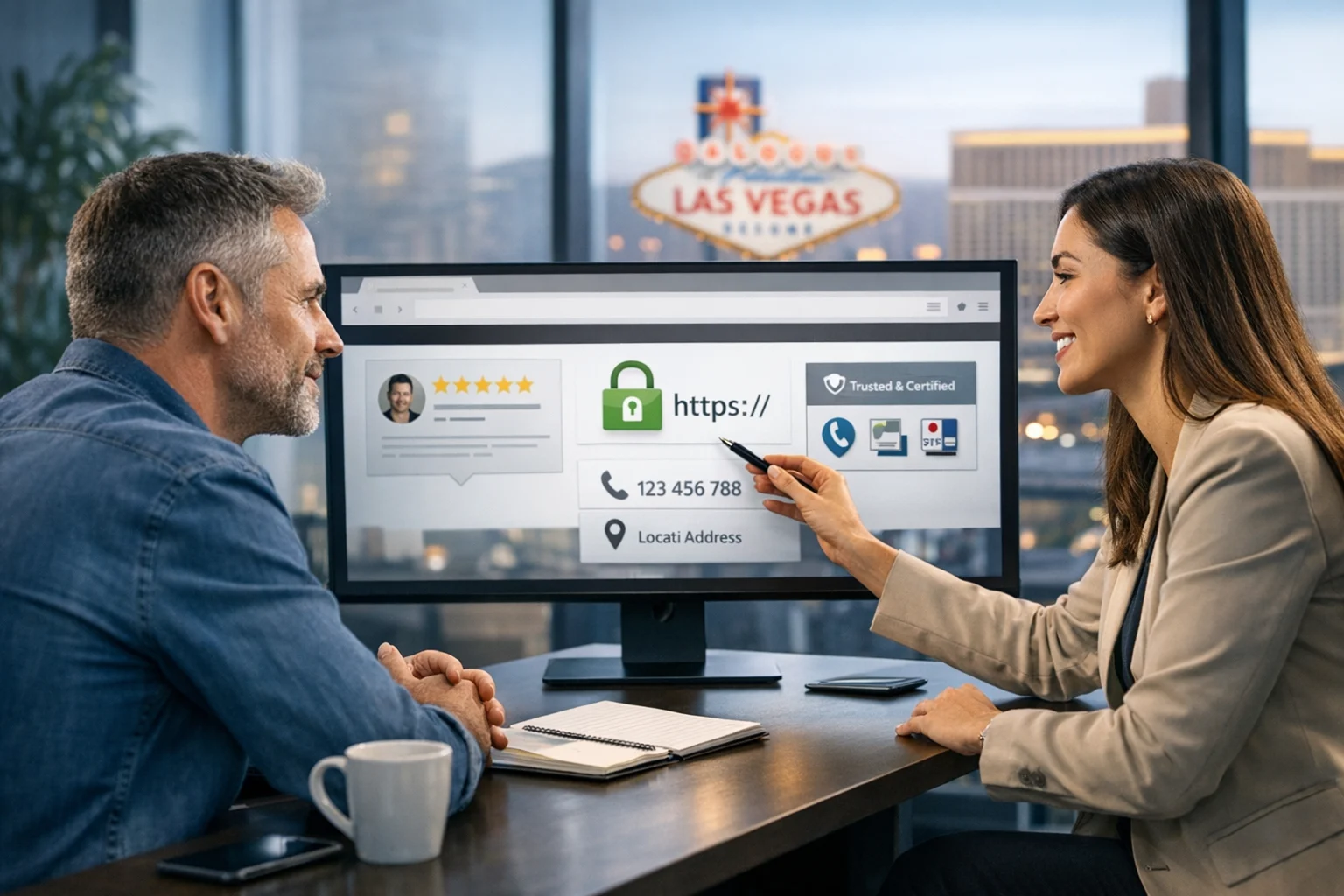
- Security cues: HTTPS, secure checkout, privacy messaging, and business website security details reduce fear.
- Team, company, or founder information: Real faces and real names build confidence.
- Relevant certifications and memberships: Industry associations, licensing, insurance, and recognized credentials help.
- Fresh content and maintenance: A site that looks updated feels safer than one frozen in 2019.
These details may seem small on their own. Together, they shape how someone feels about your business within seconds.
Why trust signals affect conversions so directly
People do business with companies they believe are competent and dependable. Your website has to communicate that before a sales conversation even begins. If it does not, visitors start looking for reasons to leave.
Think about a typical buyer journey. A prospect finds your site through Google, paid search, referral traffic, social media marketing, or a directory listing. They land on a service page. At that moment, they are not just asking whether you offer the service. They are asking whether you are safe to contact, whether you understand their problem, and whether choosing you could backfire.
Trust signals reduce that friction. They answer unspoken objections.
- “Are these people legit?”
- “Have they done this before?”
- “Will they respond?”
- “Is this website secure?”
- “Are they local, or do they just say they are?”
- “Can I trust them with my budget, customer data, or reputation?”
When a site answers those questions well, conversion rates usually improve. Not because of a gimmick, but because confidence goes up. That can mean more calls, more booked consultations, higher form completion rates, lower bounce rates, and better lead quality.
This is especially important for higher ticket services. If you are selling custom web design, technical SEO, backlink building services, cybersecurity services, penetration testing, or ongoing website maintenance, the buyer is making a more careful decision. They need evidence.
Trust signals also support SEO performance
Trust signals do not replace SEO, but they make SEO work better. Rankings bring people in. Trust signals help keep them there and move them to act.
Search engines pay attention to user behavior and site quality. If your pages look thin, outdated, confusing, or unsafe, you are not just losing conversions. You may also be weakening the user engagement signals that support performance over time. Strong trust indicators often line up with strong technical and content foundations.
For example, a well-built site with clear service pages, helpful bios, customer proof, secure architecture, and fast mobile performance usually performs better than a generic site with vague messaging. The same work that makes people trust you often improves crawlability, usability, and content depth.
For local businesses, trust and local SEO are closely connected. If your website, Google Business Profile, reviews, photos, and local citations tell a consistent story, you become easier to trust and easier to rank. If you want a deeper look at how off-site proof supports visibility, SiteLiftMedia recently covered how online reviews drive SEO and trust for local businesses.
Why this matters in Las Vegas search results
Las Vegas is a competitive market. Whether you are a law firm in Summerlin, a med spa in Henderson, a contractor serving the valley, or a hospitality brand on the Strip, searchers have options. A strong Las Vegas SEO strategy is not just about getting onto page one. It is about earning the click and then validating that click.
That means local trust signals matter a lot:
- Consistent Las Vegas service area messaging
- Local testimonials and case studies
- Google reviews with relevant service detail
- Photos of your team, office, work, or projects
- Nevada licensing or compliance details where applicable
- Local content that shows genuine market familiarity
When people search web design Las Vegas or SEO company Las Vegas, they want to know they are not dealing with a faceless operation using generic city pages. Specific, local proof makes a difference.
The design side of trust is bigger than most companies think
Design is often treated like a branding issue. In reality, it is a trust issue. Visitors instantly judge whether your company feels current, organized, and competent based on design alone.
A weak layout, clashing colors, stock-heavy imagery, cluttered calls to action, and hard-to-read text can quietly damage trust, even if your service is excellent. That does not mean every site needs to be flashy. It does mean your site should feel intentional and polished.
In our experience, companies that invest in custom web design usually see stronger engagement because the site reflects their actual value. A tailored site can position expertise better, guide users more clearly, and highlight proof in the right places. It also tends to feel more credible than a template that looks like dozens of other websites.
Design choices that increase confidence
- Clear above-the-fold messaging that explains what you do and who you serve
- Visible trust elements near calls to action
- Simple, readable layouts with strong mobile usability
- Authentic photography instead of generic filler images
- Consistent typography, spacing, and branding
- Service pages that explain process, outcomes, and next steps
Good design reduces cognitive friction. People should not have to work to understand your offer or verify your credibility.
Security is a trust signal, not just an IT task
Security often gets treated like back-end maintenance, but website visitors notice when something feels unsafe. Browsers warn users about insecure pages. Broken forms, mixed content errors, suspicious redirects, and outdated plugins can destroy confidence instantly. Even if nothing malicious happens, the perception of risk is enough to lose the lead.
For service businesses, especially those collecting contact information, payment details, or sensitive files, security should be part of the marketing conversation. Business website security supports trust in a very direct way.
Important trust-building security signals include:
- HTTPS across the full site
- Secure and tested contact forms
- Routine website maintenance and plugin updates
- Fast, stable hosting
- Clear privacy and data handling information
- Protected admin access and server monitoring
For larger organizations or businesses in regulated industries, more advanced measures matter too. Penetration testing, server hardening, cybersecurity services, and professional system administration are not just infrastructure upgrades. They reduce business risk and help protect brand trust.
If your website loads slowly, goes down often, or shows obvious technical issues, people assume the same chaos may exist behind the scenes in your service delivery.
Reviews, testimonials, and proof need context
Reviews are one of the strongest trust signals available, but they work best when they are presented with context. A row of five-star quotes with no names, no location, and no explanation is better than nothing, but it is not very persuasive.
The best testimonial content is specific. It mentions the problem, the process, and the result. It tells people what changed after working with you.
That is even more effective when paired with supporting proof such as:
- Case studies with measurable outcomes
- Before and after examples
- Industry-specific wins
- Client logos where appropriate
- Screenshots of review platforms
- Video testimonials
For local businesses, this can support both trust and search visibility. SiteLiftMedia has also written about how reviews and photos affect Google Business rankings, which ties directly into how potential customers validate your business before they ever click your website.
If you serve Las Vegas clients, do not hide the local proof. Feature testimonials from real clients in Las Vegas, Henderson, Summerlin, North Las Vegas, and nearby service areas where appropriate. That local relevance helps buyers feel like you understand their market.
Content quality is one of the strongest trust signals on the page
Thin content creates doubt. So does vague content. If your service pages are full of generic claims like “we deliver quality solutions” and “customer satisfaction is our top priority,” you are not giving buyers anything solid to believe.
Strong website copy builds trust because it sounds informed and useful. It answers real questions. It explains your process. It shows you understand the stakes. It does not dance around specifics.
For example, if you offer technical SEO, explain what that includes. Mention crawl issues, indexing, page speed, structured data, internal linking, and content architecture. If you offer backlink building services, explain your standards and how you avoid spam. If you provide system administration or server hardening, explain what gets monitored, maintained, and protected.
When content gets more specific, trust tends to rise. That is true for national audiences and even more true for local search. Businesses that invest in content expansion often see trust improve because their sites stop feeling thin. Useful blog content can also reinforce credibility over time. For Las Vegas businesses, we have covered how blogs support local SEO and help demonstrate expertise in a real, ongoing way.
Signals strong content sends to visitors
- You know your field well enough to explain it clearly
- You understand the buyer's questions and concerns
- You have a process, not just a pitch
- Your business is active and paying attention
- You can probably be trusted to handle the work professionally
Local trust signals matter even if you serve clients nationwide
Plenty of businesses work across the country while still relying heavily on strong regional demand. That is common for agencies, consultants, service companies, legal firms, and B2B providers. If that sounds like your business, local trust signals still matter because buyers often search with geographic intent even when the service can be delivered remotely.
A nationwide agency with a strong Las Vegas presence, for example, should not hide that connection. Local case studies, office or team references, Nevada business details, and city-specific service pages can support both trust and relevance. That does not mean stuffing city names into every paragraph. It means showing authentic familiarity with the market.
Searchers can usually tell the difference between a real local presence and a thin location page created just for rankings. The more credible your local footprint looks, the better.
Small trust gaps can quietly kill good traffic
One of the most frustrating situations for business owners is when the traffic numbers look decent but lead volume stays weak. In that situation, trust gaps are often the hidden issue.
Some of the most common examples include:
- No visible reviews or testimonials on key service pages
- Contact forms that feel too long or outdated
- No team page, no company story, and no local proof
- Inconsistent phone numbers, addresses, or business details
- Old blog posts and stale copyright dates
- Slow mobile performance
- Generic stock photos with no real business imagery
- No security language for data collection or checkout
- Broken links, 404 pages, and obvious maintenance issues
These are not dramatic failures, but they create hesitation. People rarely tell you that your trust signals were weak. They just leave.
How to audit trust signals on your own website
If you want a practical way to evaluate your site, step into the shoes of a skeptical first-time visitor. Do not review the site like the owner. Review it like someone who has never heard of you and is comparing three alternatives.
Ask these questions page by page
- Is it immediately clear what the business does?
- Can I verify this company is real within a few seconds?
- Do I see evidence of experience or successful outcomes?
- Is there local relevance if I searched with local intent?
- Does the design feel current and credible on mobile?
- Are forms, buttons, and calls to action easy to trust?
- Do the pages load quickly and behave normally?
- Would I feel safe sharing my information here?
Then compare your website to the top competitors in your market. Search the terms your buyers actually use, such as Las Vegas SEO, local SEO Las Vegas, web design Las Vegas, or your core service plus your city. If your site looks thinner, less polished, less secure, or less proven than the others, those trust gaps are likely costing you business.
What to fix first if your website is not converting well
You do not need a full rebuild to improve trust, though sometimes a redesign is the right move. Start with the highest-impact items first.
- Update your homepage messaging: Make your offer, audience, and differentiators clearer.
- Add stronger social proof: Place reviews, testimonials, and client results near service page calls to action.
- Improve your contact page: Include multiple contact options, response expectations, and real business details.
- Upgrade weak visuals: Replace generic images with real team, office, project, or product photography.
- Fix technical issues: Improve speed, mobile usability, and broken page problems.
- Address security basics: Review SSL, forms, updates, access controls, and visible trust cues.
- Expand thin pages: Add useful, specific service content that reflects actual experience.
Spring is often a smart time to handle this work. Many businesses use that window for redesign planning, content expansion, and infrastructure cleanup before busy seasons pick up. If your site has not had a serious trust-focused review in a while, this is usually where hidden opportunities show up.
At SiteLiftMedia, we look at trust signals as part of the bigger digital growth picture. Design, SEO, technical SEO, content, security, website maintenance, and infrastructure all need to support the same goal, making it easy for the right visitor to trust your business quickly. If you want help identifying what is building confidence and what is quietly hurting conversions, contact SiteLiftMedia and we will walk through the gaps with you.
Photo Gallery