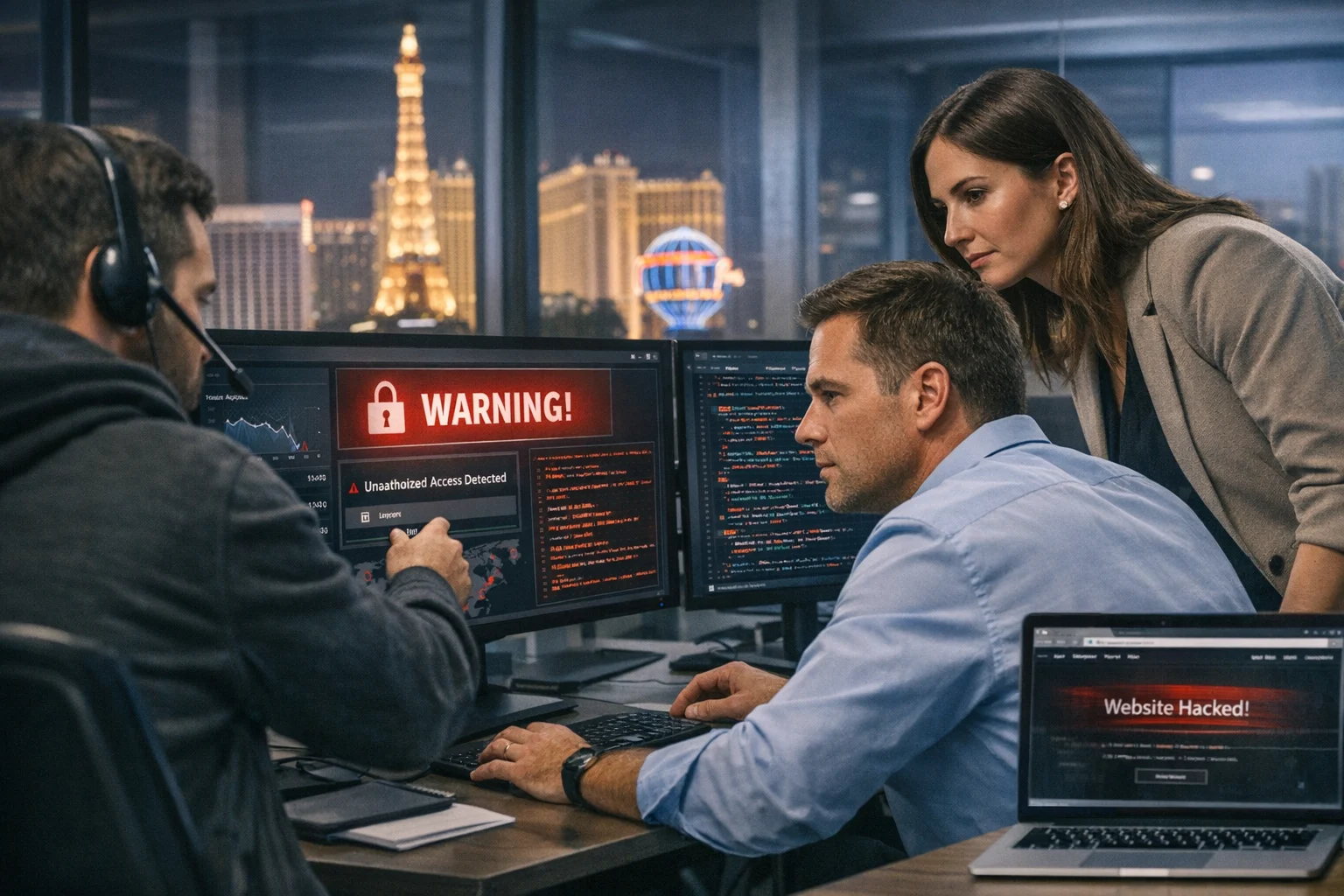
Finding out your website has been hacked is the kind of call, email, or analytics alert that can ruin a morning fast. Sometimes it shows up as a defaced homepage. Sometimes customers report spam popups, browser warnings, or strange redirects. In other cases, traffic drops, paid campaigns stop converting, and only later do you realize the site was compromised days earlier.
The first thing to know is this: don’t panic, but don’t wait. The hours right after discovery matter. What you do next can reduce lost revenue, protect customer data, preserve search visibility, and keep the situation from getting worse.
At SiteLiftMedia, we’ve seen hacked websites affect businesses in every industry, from local service companies to ecommerce brands and custom web applications. For Las Vegas businesses especially, where competition is intense and visibility matters, a hacked site can crush lead flow quickly. If you rely on Las Vegas SEO, paid traffic, local SEO Las Vegas campaigns, or seasonal promotions, even a short disruption can get expensive fast.
Here’s what to do after a website hack is discovered, in the order that usually makes the most sense.
Contain the damage first
Your first job is not to redesign the site, argue with the hosting provider, or start randomly deleting files. Your first job is to contain the incident.
If the site is actively harming users, taking it offline temporarily may be the right move. That depends on the type of compromise. A checkout page skimming credit cards, a malware redirect, or a server actively sending phishing pages is a much bigger emergency than a minor content defacement.
Start with these immediate actions:
- Put the site in maintenance mode or restrict public access if visitors are at risk.
- Disable compromised admin accounts and create a fresh administrator account if needed.
- Reset passwords for CMS logins, hosting, FTP, SSH, database users, email accounts, CDN accounts, and any linked third party services.
- Force logout sessions where your platform allows it.
- Pause risky integrations such as unknown plugins, suspicious API connections, or recently added code snippets.
- Alert the right internal people immediately, including leadership, IT, marketing, and anyone handling customer communications.
If you’re running paid ads, social media marketing campaigns, or email traffic into the website, consider pausing those campaigns until you confirm users are safe. Sending paid traffic to a compromised site wastes budget and can create trust issues that linger long after the cleanup.
For businesses in competitive markets like Las Vegas, this step matters even more. If your website supports lead generation, reservations, legal consultations, home services, or ecommerce orders, even a few hours of exposure can lead to customer complaints and reputation damage.
Preserve evidence before you start cleaning
One of the most common mistakes after a website hack is jumping straight into cleanup without preserving anything. It feels productive, but it can make the incident harder to understand and easier to repeat.
Before you change too much, save what you can:
- Take a full backup or server snapshot of the current compromised state.
- Export server logs, access logs, error logs, firewall logs, and authentication logs.
- Document what you observed, including screenshots of warnings, redirects, injected pages, fake admin users, or file changes.
- Record timestamps from when suspicious behavior began, if known.
- Check monitoring tools like Google Search Console, uptime tools, malware alerts, and hosting notifications.
This matters because the obvious symptom is often not the real entry point. A spam page in your index may have started with a vulnerable plugin. A fake admin account may have started with reused credentials. A malicious script in your theme may actually be the result of a server-level compromise.
If your team doesn’t handle incident response often, don’t guess. A sloppy cleanup can leave behind backdoors, scheduled tasks, hidden user accounts, or database injections that reinfect the site later. That’s one reason many businesses bring in expert help early. SiteLiftMedia provides cybersecurity services, website maintenance, and system administration support for businesses that need the investigation done properly.
If you want a deeper look at safe cleanup steps, this guide on how to clean a hacked website without making it worse is worth reading before anyone starts deleting files.
Figure out how far the compromise goes
After you’ve contained the incident and preserved evidence, the next step is scope. You need to know what was affected.
That means looking beyond the homepage. In many cases, the visible problem is just one piece of a bigger issue.
Check the website itself
- Core CMS files
- Themes and plugins
- Uploads directories
- Injected JavaScript in templates or header files
- New admin users or changed permissions
- SEO spam pages and hidden links
- Redirect rules in .htaccess, server config, or application routing
Check the database
- Injected scripts in posts, pages, widgets, or custom fields
- Suspicious admin users
- Modified settings
- Phishing content or cloaked landing pages stored in tables
Check the server and infrastructure
- Unfamiliar cron jobs or scheduled tasks
- Backdoor files with random names
- Modified system binaries or permissions
- Open ports or misconfigurations
- Signs of lateral movement into other sites on the same server
Check connected services
- Email accounts sending spam
- Cloud storage
- CDN or DNS changes
- Payment gateways
- REST APIs and custom integrations
This is where hands-on experience matters. A modern website is rarely just a few HTML pages. It’s a stack: CMS, hosting, plugins, APIs, analytics, forms, email, CRM integrations, ecommerce tools, and sometimes custom code. If one layer is compromised, the others need review too.
Custom platforms deserve extra caution. If you have a booking engine, member portal, custom web design project, or application with API endpoints, the issue might not be malware in a theme file at all. It could be an authentication flaw, an exposed token, or a vulnerable endpoint. Businesses relying on app development and integrations need a broader review than a simple malware scan.
Close the entry point before you restore anything
Restoring a clean backup sounds like the fastest fix, and sometimes it is part of the solution. But if you restore the site before closing the entry point, there’s a good chance it gets hacked again.
Find and fix the likely cause first. Common causes include:
- Outdated CMS core, plugin, or theme files
- Weak or reused passwords
- Compromised admin credentials
- Missing multi factor authentication
- Poor file permissions
- Outdated server software
- Unpatched vulnerabilities
- Insecure third party code snippets
- Shared hosting contamination
- Exposed admin panels or remote access ports
Once you know the likely path in, take hardening seriously:
- Patch everything that needs updating.
- Remove unused plugins, themes, extensions, and scripts.
- Rotate credentials across all related systems.
- Enable multi factor authentication for admin access.
- Review user roles and apply least privilege.
- Lock down file permissions and disable risky write access where possible.
- Implement server hardening and review firewall rules.
- Restrict admin access by IP or VPN if that fits the environment.
For businesses running older websites, this moment often exposes a bigger issue: the site has been neglected for too long. Maybe nobody has been handling website maintenance. Maybe the original developer disappeared. Maybe a redesign was postponed for three years and now the codebase is fragile. If that sounds familiar, the incident may be telling you more than just “you got hacked.” It may be telling you the entire web stack needs attention.
Patch discipline is a huge part of that. If your team needs a quick read on why this matters, SiteLiftMedia covers it here: why patch management matters for website security.
Clean the site thoroughly, not cosmetically
A lot of hacked sites get “fixed” in a way that only removes the visible symptom. The homepage looks normal again, but the malicious code is still sitting in a plugin directory, in the database, or in a scheduled task waiting to fire later.
Proper cleanup usually includes:
- Comparing current files against known clean versions
- Removing injected scripts and backdoors
- Reviewing the database for malicious entries
- Deleting unauthorized users
- Replacing compromised core files from a trusted source
- Reviewing custom code changes line by line where needed
- Scanning public and non public directories
- Checking logs to confirm suspicious activity stops after remediation
This is also the point where many businesses discover SEO spam. Hackers often inject doorway pages, hidden links, pharmaceutical content, casino spam, or local landing pages stuffed with junk keywords. If you’re investing in Las Vegas SEO or working with an SEO company Las Vegas businesses depend on for lead generation, those spam pages can quietly damage rankings, index quality, and brand trust.
That’s why cleanup needs both file and database review. If your team wants more context on that, this article on why hacked website cleanup needs file and database review explains the risk well.
Check whether customer data or business systems were affected
Not every website hack leads to a data breach, but you shouldn’t assume customer data is safe until you verify. Ask the hard questions:
- Were contact forms exposed?
- Was customer account data accessed?
- Were payment details touched?
- Did hackers gain access to internal email accounts?
- Were there downloads of sensitive documents or proposals?
- Did the site connect to CRM, ERP, or marketing automation systems?
If sensitive data may have been exposed, legal, compliance, and notification obligations may apply depending on your industry, state, and customer base. If you process payments, involve the appropriate payment processor and follow PCI-related guidance. If healthcare, finance, or regulated data is involved, don’t keep this purely inside the marketing department.
This is where strong system administration and cybersecurity services make a real difference. A hacked marketing site is one thing. A compromised business system connected to the website is another level entirely.
Request blacklist review and fix browser warnings
If the hack triggered browser alerts, antivirus flags, or search engine warnings, cleanup alone won’t always restore trust. You also need to get the site reviewed and remove blacklist status.
Check:
- Google Search Console security issues
- Safe Browsing warnings
- Hosting provider abuse notifications
- CDN or firewall platform alerts
- Email delivery reputation if spam was sent from your domain
After the site is cleaned and hardened, submit the appropriate review requests. Do not request review too early. If malware or redirects are still present, the request can be denied and you lose time.
For local businesses in Las Vegas, this matters more than most people realize. A browser warning can destroy conversion rates for branded searches overnight. People searching for a contractor, law firm, med spa, restaurant, or service provider in a hurry won’t troubleshoot your website. They’ll go to the next result.
Audit SEO damage before traffic loss becomes permanent
Business owners often focus on “is the site back online?” Marketing teams need to ask a second question: “What did this do to search performance?”
A hack can damage SEO in several ways:
- Spam pages get indexed
- Title tags and meta descriptions are overwritten
- Important pages are redirected elsewhere
- Canonical tags are changed
- Internal links are manipulated
- Sitemaps are replaced
- Core Web Vitals and site speed deteriorate
- Google distrusts the domain temporarily
That means your recovery plan should include technical SEO, not just malware removal. Review Search Console coverage, indexed pages, crawl errors, manual actions, sitemap integrity, robots.txt, and major page templates. Check your analytics for the exact point traffic fell. Compare ranking losses across branded, transactional, and local terms.
If you target terms like web design Las Vegas, SEO company Las Vegas, local SEO Las Vegas, or other high-intent local phrases, you need to know whether the hack disrupted those pages specifically. In local search, small trust signals matter. If your top service pages were altered, deindexed, or slowed down, visibility can slide fast.
It’s also smart to review backlinks after a hack. Sometimes attackers create outbound spam links. Other times they generate junk pages that attract bad backlinks. If your growth strategy includes backlink building services, clean link evaluation becomes part of the recovery picture.
Use the incident as a chance to fix deeper website problems
Here’s the uncomfortable truth: hacked websites are often sitting on a pile of technical debt before the attack ever happens. Outdated code, plugin bloat, sloppy user permissions, abandoned landing pages, no maintenance plan, weak hosting setup, and no one really owning the stack. The hack just makes the problem visible.
That’s why recovery should include infrastructure cleanup, not just emergency remediation. In many cases, the right move after stabilization is to plan one or more of the following:
- Ongoing website maintenance so updates and monitoring aren’t ignored
- Server hardening to reduce future attack surface
- Penetration testing to identify what automated scans miss
- Technical SEO cleanup so search visibility rebounds correctly
- Custom web design or redevelopment if the current site is brittle or outdated
- System administration oversight for businesses with more complex hosting or cloud environments
Penetration testing is particularly valuable after a hack because it helps validate whether the original weakness has truly been closed. SiteLiftMedia covers that in more depth here: how penetration testing prevents costly website incidents.
For companies planning spring marketing pushes, content expansion, or a redesign, this is also a smart time to think strategically. If your website was already underperforming before the breach, rebuilding on a cleaner, more secure foundation may be smarter than patching a weak setup forever.
Coordinate marketing, IT, and leadership so recovery is faster
Website incidents drag on when nobody owns the full process. Marketing is waiting on IT. IT is waiting on hosting. Leadership wants updates. Agencies are missing access. Customers are asking questions. That kind of confusion is common, and it’s expensive.
The best recoveries usually have one person coordinating:
- Technical investigation and cleanup
- Hosting and DNS communication
- Customer communication if needed
- Search engine review requests
- Ad campaign pauses and restarts
- SEO monitoring after the fix
- Documentation for future prevention
If your internal team isn’t set up for that, outside support can save time and reduce mistakes. That’s especially true for multi-location businesses, ecommerce stores, or companies with custom integrations and active lead generation campaigns.
Know when to call in outside help
You probably need an experienced agency or security team if any of these are true:
- You don’t know how the hack happened
- The site keeps getting reinfected
- You process payments or sensitive customer data
- There are custom applications or API connections involved
- Google is showing security warnings
- Organic traffic or conversions dropped sharply
- Your hosting environment needs deeper review
- You suspect the compromise reached email or internal systems
SiteLiftMedia helps businesses handle exactly this kind of situation with practical support that connects security, web operations, and growth recovery. That can include hacked website cleanup, cybersecurity services, penetration testing, website maintenance, system administration, server hardening, technical SEO, and redevelopment when the underlying platform needs more than a patch job.
For Las Vegas companies, that combination matters. A business website isn’t just a digital brochure. It’s sales infrastructure. If your rankings, lead forms, booking flow, or customer trust take a hit, the impact is immediate. Whether you need incident response, a stronger web design Las Vegas strategy, or a long-term partner for SEO and infrastructure cleanup, the right fix is the one that makes the site safer and more profitable after the crisis, not just online again.
If your website has been hacked and you need a real recovery plan, contact SiteLiftMedia. We’ll help you contain the damage, clean the site correctly, lock down the environment, and repair the SEO and performance issues that often get missed in a rushed fix.
Photo Gallery