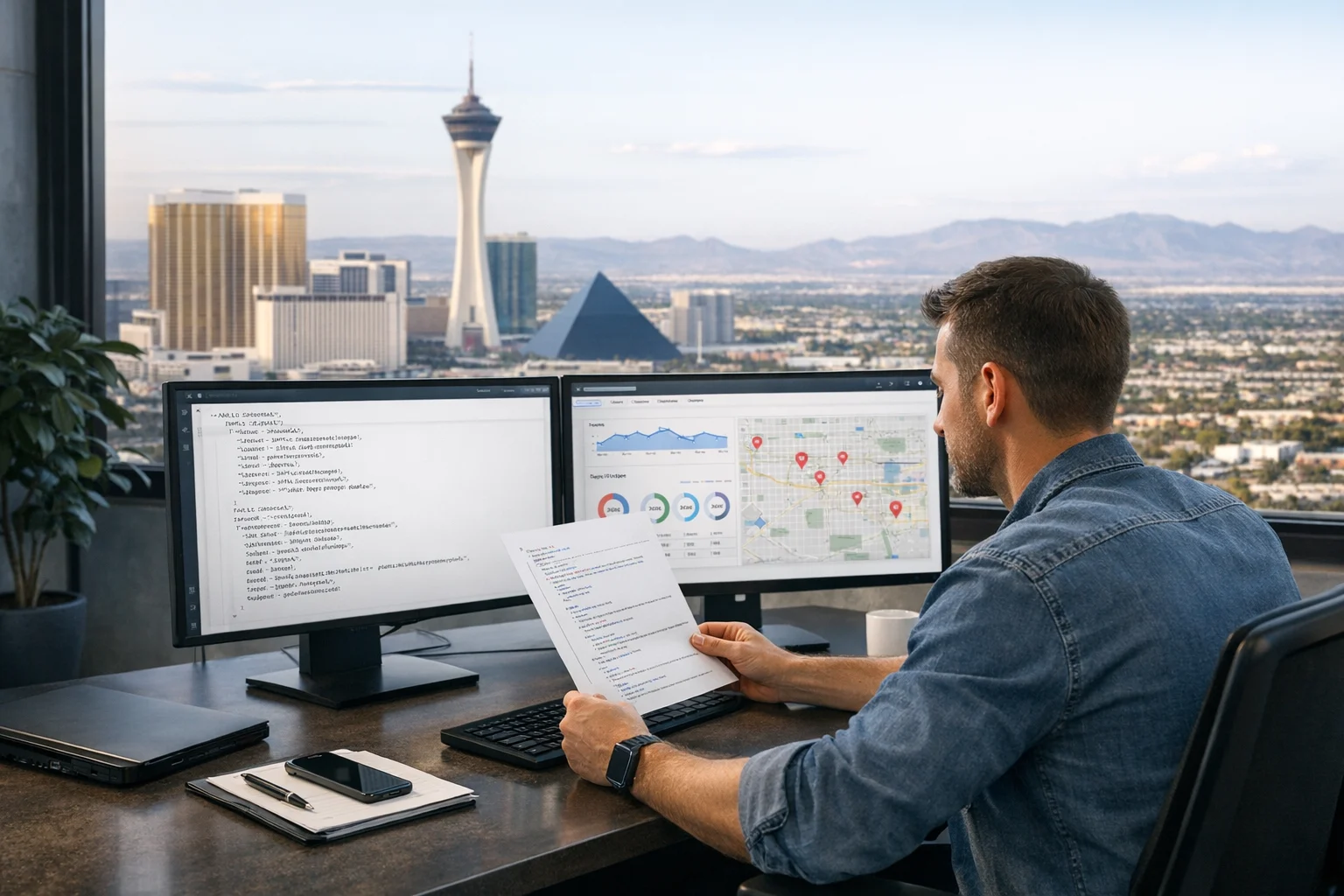
AI is part of nearly every marketing conversation right now, but most businesses are still stuck on the same question: how do you use it in a way that actually drives revenue? For companies in competitive markets like Las Vegas, the answer usually is not AI on its own. It is AI tied to a serious SEO strategy, clean data, a fast website, and a conversion process that turns search traffic into booked jobs, consultations, orders, or calls.
That matters because Las Vegas SEO is rarely straightforward. Search intent shifts quickly. Tourists, locals, convention traffic, seasonal demand, and aggressive competitors all influence what people search for and when they search. If your business is running on generic content, outdated pages, or disconnected software, AI can make the problem worse. When it is integrated the right way, though, AI can sharpen your local SEO Las Vegas strategy, help your team move faster, improve lead handling, and uncover ranking opportunities you might otherwise miss.
At SiteLiftMedia, we treat AI as an accelerator, not a replacement for strategy. The strongest results usually come from pairing AI tools with technical SEO, custom web design, local search intent, and disciplined execution. That applies to Las Vegas businesses first, but the same approach works for companies nationwide that want stronger visibility and better digital performance.
Why AI and SEO need to be planned together
A lot of businesses adopt AI backwards. They start with a tool, then try to invent a reason to use it. That usually leads to auto generated content nobody wants to read, weak landing pages, and reporting that looks impressive but does not move the business forward. SEO works differently. It starts with demand, relevance, authority, crawlability, and user experience. AI should support those fundamentals.
Think about what SEO already involves. You need keyword research, search intent mapping, competitor analysis, content planning, technical cleanup, internal links, conversion tracking, page speed improvements, local signals, and backlink strategy. AI can help in every one of those areas, but only when the business goal is clear from the start.
For a local service brand in Southern Nevada, that might mean increasing map pack visibility for high value searches. For an ecommerce company, it could mean improving category copy and reducing site friction. For a multi location brand, it may mean scaling city pages without creating duplicate junk. In each case, AI integration works best when the SEO foundation is already in place.
Start with business goals, not software features
If you want real growth, start by identifying the search journeys that produce revenue. Not all traffic is equal. A page that brings in ten qualified leads is worth more than a blog post that drives a thousand unqualified visits. That sounds obvious, but teams miss it all the time when they chase volume instead of business outcomes.
Map the revenue path first
- Which services or products have the best margins?
- Which searches show buying intent right now?
- Which pages already convert, even with low traffic?
- Where are leads dropping off after they land on the site?
- What local areas around Las Vegas matter most for growth?
Once you know that, AI becomes much more useful. It can cluster keywords by intent, surface gaps in your service pages, analyze call transcripts for recurring questions, and help uncover what prospects care about before they contact you. That is very different from asking a chatbot to write twenty pages and hoping Google sorts it out.
For many businesses, this is also the stage where it helps to work with an agency that can connect strategy to execution. If you are evaluating an SEO company Las Vegas business owners can trust, look for a team that can talk about search intent, web infrastructure, content quality, lead tracking, and conversion rate optimization in the same conversation. Those pieces need to work together.
AI integrations that actually improve SEO performance
The best AI use cases in SEO are usually less flashy than people expect. They are operational. They save time, reduce guesswork, and help your team make better decisions faster.
Smarter keyword and intent clustering
AI can quickly group search terms by theme, buyer stage, urgency, and location. That helps you build a page structure that reflects how people actually search. In Las Vegas, that may mean separating broad informational content from high intent searches tied to neighborhoods, emergency services, same day service, or industry specific needs. If you want more ideas that fit real operations, this guide on AI integration ideas for Las Vegas businesses that save time is worth a look.
Content operations without thin content
AI is useful for outlines, topic clustering, FAQ extraction, summary generation, and spotting missing subtopics. It can help your writers move faster, but it should not replace subject matter expertise. Strong SEO content still needs original insight, local context, and a clear point of view. That is especially true when you are trying to rank for terms like Las Vegas SEO, local SEO Las Vegas, or web design Las Vegas, where search engines already see a lot of repetitive content.
Good content answers real objections. It explains process. It shows proof. It covers what pricing depends on. It anticipates buyer hesitation. AI can help organize that material, but your business still has to provide the substance.
Lead handling and conversion feedback
One of the smartest AI integrations has nothing to do with publishing content. It is using AI to analyze what happens after the click. Call recordings, form submissions, live chat logs, and CRM notes can reveal why certain keyword groups convert better than others. They can also show which landing pages bring in poor fit leads, which questions your team answers over and over, and what messaging closes the most deals.
When you feed that insight back into SEO, your pages become more persuasive. Service descriptions get sharper. FAQs become more useful. Calls to action become more specific. Search traffic improves not just in quantity, but in quality.
Where local SEO in Las Vegas gets the biggest lift
Local search is where AI and SEO can create quick wins for many Nevada businesses, especially service companies, professional practices, hospitality adjacent brands, and local retailers. Local SEO Las Vegas performance depends on relevance, proximity, trust, and strong business signals. AI helps by making local optimization more consistent and more data driven.
Start with your Google Business Profile, your primary service pages, and your location signals across the site. AI can help identify patterns in reviews, common customer questions, peak inquiry windows, and service modifiers that matter in local searches. It can also help your team organize content ideas for neighborhood pages, service area pages, and FAQs that reflect real customer language.
For businesses trying to improve local reach, this resource on building a stronger local SEO presence in Las Vegas pairs well with a broader AI strategy because it focuses on the signals that actually affect visibility.
Build around local intent, not just city mentions
Many businesses think local SEO means repeating Las Vegas across the site. That is not enough. Search engines want clearer evidence. Your pages should line up with actual local search patterns, such as emergency intent, service plus area combinations, problem based searches, and industry terms tied to local demand. A business serving Summerlin, Henderson, North Las Vegas, and Paradise should think carefully about where separate pages make sense and where a stronger core service page is the better move.
AI can help cluster these modifiers, but a human still needs to decide whether the resulting page will be genuinely useful. That is where experience matters.
Technical SEO and custom web design still decide who wins
There is no AI shortcut for a weak website. If your site loads slowly, breaks on mobile, confuses users, or makes it hard for search engines to crawl key pages, you will cap your growth no matter how advanced your content process looks.
That is why technical SEO and custom web design need to be part of the same growth plan. In practice, we often see Las Vegas businesses invest in campaigns before fixing the website itself. Then they wonder why rankings stall or why leads do not improve. A cleaner architecture, better internal linking, faster page speed, stronger calls to action, and page templates built for intent can change performance more than publishing another ten average articles.
This is especially relevant for companies shopping for web design Las Vegas services. Design should not be treated as cosmetic. It affects engagement, trust, conversion rate, and crawl efficiency. A custom web design approach can also make it easier to scale SEO because your templates support service pages, location pages, FAQs, schema, and content updates without constant patchwork.
If your foundation is shaky, start there. Site structure, indexing issues, redirect problems, image optimization, Core Web Vitals, and mobile usability are still central to growth. Businesses that outperform in crowded markets usually handle the technical side better than their competitors.
Use AI to expand visibility beyond classic search
Search behavior is changing. People still use Google, but they also ask AI tools direct questions, compare vendors in chat interfaces, and rely on summarized answers before they ever click a website. That does not mean SEO is dead. It means your strategy needs to cover both traditional rankings and answer readiness.
This is where content structure matters. Clear headings, concise explanations, strong service pages, helpful FAQs, original data, and trustworthy brand signals all increase the chances that your business gets pulled into answer driven experiences. If your content is vague or generic, it is much less likely to show up in useful ways.
SiteLiftMedia has covered this in more detail here: AEO vs SEO and how businesses should use both. For Las Vegas companies, this matters because local decision making often happens fast. A user may compare several providers, skim answers, then choose the business with the clearest proof and the easiest next step.
AI can also support repurposing. One strong article can become FAQ snippets, short videos, sales enablement notes, and assets for social media marketing. That helps reinforce topical authority across channels without forcing your team to start from scratch every time.
Backlink building services need strategy, not automation
Backlinks still matter, especially in competitive verticals. What has changed is how easy it is to create worthless outreach at scale. AI can help identify prospects, categorize websites, summarize outreach targets, and speed up research. It should not be used to flood inboxes with generic spam.
Quality backlink building services focus on relevance and credibility. For a Las Vegas business, that might include local publications, chambers, associations, sponsorships, partner businesses, event coverage, niche directories, and editorial mentions tied to expertise. For nationwide campaigns, it may include industry resources, digital PR, thought leadership, and data backed content.
The strongest links usually come from assets worth citing. Case studies, local market guides, expert commentary, original research, and genuinely useful tools give outreach teams something meaningful to pitch. AI can help package the information, but it cannot create real authority on its own.
Security and infrastructure matter more than most marketers admit
Once AI and SEO start driving more traffic, your website becomes an even more valuable business asset. That means uptime, protection, and stability matter. It is hard to grow search visibility if the site is hacked, slowed down by server issues, or compromised by neglected plugins and weak access controls.
This is one area where business owners often separate marketing from operations, even though the two are tightly connected. Technical SEO depends on reliable hosting, clean code, and stable deployment practices. Rankings can drop when pages disappear, malware warnings appear, or performance degrades after a neglected update.
That is why services like website maintenance, system administration, server hardening, penetration testing, and broader cybersecurity services belong in the growth conversation. Business website security is not just an IT checkbox. It protects SEO equity, customer trust, lead flow, and ad performance. For companies handling customer data, online payments, bookings, or sensitive forms, it is even more critical.
At SiteLiftMedia, we see this regularly with businesses that have invested heavily in visibility but underinvested in infrastructure. Security readiness supports marketing. It is part of the same system.
Q4 planning, holiday traffic, and campaign timing
Las Vegas businesses often deal with sharp seasonal swings, whether they serve consumers, events, tourism related demand, hospitality vendors, or B2B clients trying to finish the year strong. Q4 can create major opportunity, but only if preparation starts early enough.
AI can help forecast demand shifts using historical analytics, search trends, CRM activity, and campaign performance. That gives your team a head start on content refreshes, service page expansion, internal linking updates, and promotional planning. If you wait until holiday traffic hits, you are already behind.
This is also where SEO and paid media should support each other. PPC can test messaging quickly, fill visibility gaps, and capture urgent demand while SEO builds stronger long term rankings. If you want a practical look at that relationship, SiteLiftMedia breaks it down here: how to combine PPC and SEO for better long term growth.
Performance tuning matters here too. Landing pages should be fast, forms should work flawlessly, phone tracking should be accurate, and content should reflect current offers, hours, and buyer concerns. Businesses that prepare for seasonal surges tend to convert more from the same traffic.
What to measure if you want growth, not just activity
Once AI is involved, teams can end up reporting a lot of motion that looks impressive but does not help leadership make decisions. Better dashboards stay focused on commercial outcomes.
- Organic leads by service line and location
- Qualified call volume from local and non brand search
- Google Business Profile actions and direction requests
- Conversion rate by landing page and keyword theme
- Page speed and mobile engagement trends
- Content production time saved through AI workflows
- Lead quality patterns found in call and CRM analysis
- Revenue influenced by SEO and assisted channels
Those numbers show whether AI is making the SEO program better, or just faster. Faster only matters if quality stays high. In many cases, the real win is not publishing more content. It is identifying the right pages to improve, the right service areas to target, and the right objections to answer.
When it makes sense to bring in agency help
Most business owners and marketing managers do not need another disconnected tool. They need a system. That usually means aligning strategy, web design, technical SEO, analytics, content production, lead tracking, paid media, and site security under one plan.
If your team is trying to juggle AI tools, manage vendors, update the website, improve rankings, monitor cybersecurity, and still run the business, the work can fragment quickly. That is where agency support can save time and improve results. SiteLiftMedia works with companies that need more than a generic checklist. We help connect AI integration to real SEO performance, stronger websites, better conversion paths, and healthier digital infrastructure.
If you want a practical roadmap for Las Vegas SEO growth, or you need a nationwide strategy with a strong local search angle, contact SiteLiftMedia. We can audit your current setup, show you where AI will actually help, and build a plan that supports rankings, leads, performance, and security without wasting time on gimmicks.
Photo Gallery