Topical authority gets talked about like some abstract SEO theory, but for a local service business, it’s much more practical than that. It means your website clearly shows that you know your services, your market, and the questions buyers ask before they hire someone. When that happens, search engines trust your site more, and real people do too.
For a plumber, roofer, law firm, med spa, HVAC company, electrician, managed IT provider, or home services brand, topical authority can be the difference between a website that quietly exists and one that consistently brings in calls, form fills, and booked appointments. It matters even more in competitive metro areas where search intent is high and crowded, especially for terms tied to Las Vegas SEO, local SEO Las Vegas, and service-driven searches with commercial intent.
At SiteLiftMedia, we’ve seen this firsthand. A lot of business owners invest in a nice-looking site, maybe some PPC, maybe a few service pages, then wonder why rankings plateau. The issue usually isn’t effort. It’s coverage. The site doesn’t fully cover the service topics, local context, and trust signals needed to become the obvious choice in Google’s eyes.
If you want to build topical authority for a local service business website, you need more than a blog and a homepage. You need structured service coverage, local relevance, technical SEO that supports crawling and indexing, strong internal links, and enough real depth to show that your business isn’t just dabbling in the topic. You own it.
What topical authority actually means for a local business
Topical authority is your site’s demonstrated expertise around a subject area. For a local service business, that subject area usually sits at the intersection of service + location + buyer intent.
For example, if you run an HVAC company in Las Vegas, topical authority isn’t just one page targeting “HVAC Las Vegas.” It’s a network of useful pages that cover AC repair, AC replacement, ductwork, thermostat upgrades, maintenance plans, emergency calls, indoor air quality, commercial HVAC, service areas, pricing questions, and the common problems local customers deal with in desert heat.
Google wants to rank websites that look complete, credible, and useful. Your site should answer questions like these without making users dig:
- What services do you offer?
- Who are those services for?
- Where do you provide them?
- What problems do you solve?
- Why should someone trust your business over competitors?
- How can a visitor take the next step quickly?
The businesses that win in local search don’t just target keywords. They build a content and site structure that makes the website feel like a true local resource.
Start with a service and location map, not random content ideas
The fastest way to waste time is by publishing articles with no structure behind them. Topical authority starts with mapping the business.
Begin by listing every core service your business offers. Then break each one into meaningful subtopics. After that, match those services to priority locations. This creates the framework for your website.
Your foundation should include
- Main service pages
- Subservice pages
- Industry or audience-specific pages if relevant
- City or service area pages
- FAQ content tied to service intent
- Blog or resource articles that support buying decisions
Let’s say you’re a cybersecurity and IT support company serving Nevada businesses. Your topic map might include managed IT services, penetration testing, cybersecurity services, system administration, server hardening, business website security, network monitoring, compliance support, and website maintenance. Then you pair those with market pages for Las Vegas, Henderson, Summerlin, and broader Nevada service terms where appropriate.
That kind of structure sends a very different signal than a site with one “IT Services” page and a handful of disconnected blog posts.
This is also where many agencies miss the mark. They chase volume instead of buyer intent. For local service businesses, the strongest topical authority usually comes from covering the terms that help people hire, compare, and trust you, not just browse.
Build commercial pages first because they carry the most SEO value
Business owners often want to start with blog content because it feels easier. In reality, your money pages need attention first. If the service pages are thin, generic, or poorly structured, supporting content won’t have much to reinforce.
Each core service page should do more than name the service and ask for a call. It should explain the work, define common use cases, answer objections, show service options, and create internal pathways to related topics.
Strong service pages usually include
- A clear service definition
- Specific problems the service solves
- Who the service is for
- What the process looks like
- Related subservices or packages
- FAQs based on real sales conversations
- Relevant city or service area references
- Strong calls to action
If you’re targeting web design Las Vegas or custom web design for service businesses, a good page should speak to lead generation, mobile usability, speed, trust, conversion design, maintenance needs, and integration with broader marketing. A weak page just says you build websites and adds a contact form.
This is especially important for competitive local terms like SEO company Las Vegas or local SEO Las Vegas. Search engines see dozens of businesses trying to rank for those phrases. The pages that rise are usually the ones that show real expertise, not shallow sales copy.
Create support content clusters around each service line
Once your commercial pages are solid, build supporting content around them. This is where topical authority starts to compound.
Every major service should have a cluster of articles, FAQs, or guides that answer related questions from actual prospects. Think about the issues that come up during sales calls, consultations, estimates, support requests, or onboarding. Those are your best content prompts.
For example, an HVAC company might create supporting content like
- How often AC systems need maintenance in Las Vegas heat
- Signs it’s time to replace an aging unit
- Why some homes have uneven cooling
- What affects AC installation cost
- Emergency repair vs full replacement
A digital agency or IT firm might cover topics like
- How technical SEO affects lead generation
- When a website refresh project makes sense
- What website maintenance should include
- How server hardening supports business continuity
- Why penetration testing matters for growing companies
Good support content doesn’t exist to fill a blog calendar. It exists to strengthen the site’s expertise around the topics that matter most to buyers. Every article should connect back to a relevant service page and help the user move closer to action.
If you’re not sure where the gaps are, start with a content and architecture review. SiteLiftMedia has covered how to audit a website for organic traffic opportunities, and that process often reveals exactly where a local service site lacks depth.
Use local relevance in a way that feels earned
One of the biggest mistakes we see with local websites is fake localization. Businesses stuff city names into every paragraph, publish low-value location pages, and expect that to count as local authority. It usually does the opposite.
Real local topical authority comes from showing a genuine relationship between your services and the markets you serve.
For Las Vegas businesses, that might mean referencing:
- Local climate and its effect on home services
- Seasonal demand cycles
- Commercial growth corridors
- Tourism-driven business needs
- Neighborhood or service area distinctions
- Operational considerations unique to Southern Nevada
If you provide SEO, web design, PPC, or social media marketing in Nevada, local relevance can also come from discussing what competition actually looks like in Las Vegas search results. Map pack visibility, review velocity, service area overlap, and local landing page quality all matter.
That’s why Google Business Profile support should sit alongside website authority building. If local visibility is part of your strategy, review your listings, categories, services, and location signals regularly. SiteLiftMedia has published guidance on Google Business Profile mistakes that hurt local rankings and how Las Vegas businesses can improve map pack rankings. Those pieces pair naturally with a topical authority plan because your site and your GBP should reinforce the same themes.
Strengthen site architecture and internal linking
Topical authority is not just about what you publish. It’s also about how clearly your site organizes that information.
When your website has clean architecture, search engines can understand the relationships between pages more easily. Users can also move from broad topics to specific solutions without hitting dead ends.
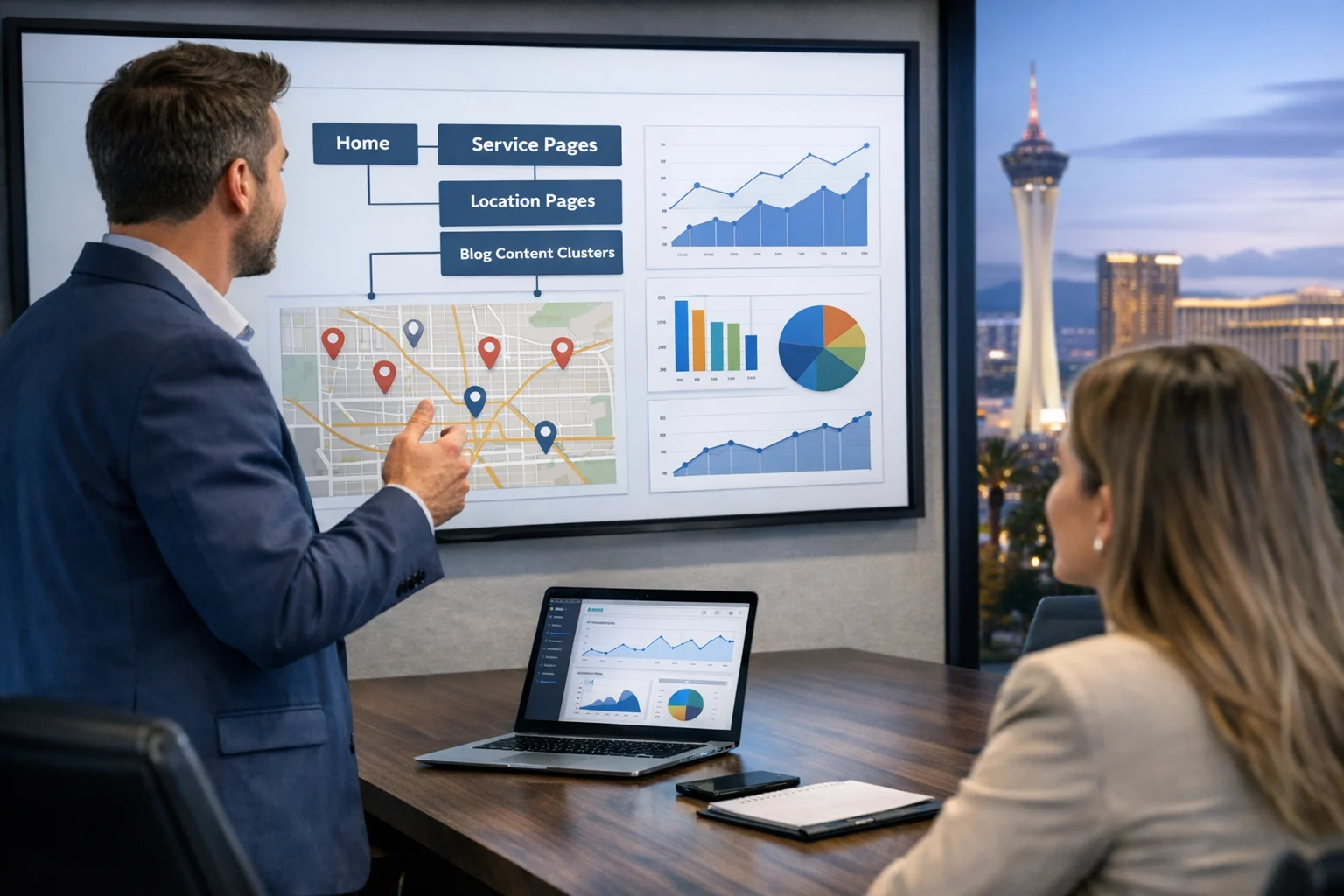
A practical structure often looks like this
- Homepage
- Main services hub
- Individual service pages
- Subservice pages or industry pages
- Location pages where truly relevant
- Resource articles tied to each service cluster
Then use internal links intentionally. Your AC repair page should link to maintenance, replacement, emergency service, and related FAQ content. Your cybersecurity services page should connect to penetration testing, business website security, system administration, and server hardening content. Your custom web design page should support related pages about website maintenance, UI decisions, conversion strategy, and technical SEO.
Internal linking is one of the simplest ways to help search engines understand topical depth, yet it’s often neglected. The fix isn’t complicated. Build content in clusters and link with purpose.
Technical SEO matters because authority needs a stable foundation
Plenty of local businesses create good content and still struggle because the site itself is hard to crawl, slow to load, or poorly built on the back end. Topical authority won’t reach its full value if technical SEO is weak.
At minimum, your website should have:
- Fast load times on mobile and desktop
- Clean indexing rules
- Logical URL structure
- Strong page titles and meta data
- Usable navigation
- Schema where appropriate
- Secure hosting and SSL
- No major crawl errors or duplicate page problems
For service businesses investing in growth, technical SEO should be treated like infrastructure, not cleanup work you only do after traffic drops. This is especially true if you’re redesigning a site, adding many service pages, or expanding into multiple markets.
Good technical health also supports trust in a broader sense. If your business site is slow, broken, or visibly neglected, users feel it. If it’s insecure, that becomes an even bigger problem. Site performance, website maintenance, and business website security all support the credibility of your content.
SiteLiftMedia often works with clients who need more than content updates. They also need system administration, cybersecurity services, server hardening, or a more dependable website stack so the marketing work can scale safely. That’s part of authority too. A trustworthy site should actually be trustworthy.
Earn backlinks that reinforce the topic, not just the homepage
Backlinks still matter, especially in competitive local markets. But not all links help topical authority in the same way.
If every link points to your homepage, you’re leaving a lot on the table. Service pages, city pages, and high-value resources should attract links too. The best link building plans support the exact areas where you want stronger authority.
Useful link sources for local service businesses include
- Industry associations
- Local chambers and business groups
- Relevant directories with editorial standards
- Partner and vendor mentions
- Local PR opportunities
- Guest contributions on relevant industry sites
- Resource-driven outreach to useful content assets
This is where many businesses waste money on low-quality backlink building services that create volume without relevance. A handful of strong, contextually appropriate links to the right pages often does more than a large batch of weak placements.
If you’re actively building authority, it’s worth thinking about outreach as an extension of your content strategy. SiteLiftMedia has shared practical ideas on link building outreach tactics for agencies and growing brands, and the same principles apply to local service companies that want links supporting real business pages.
Cover adjacent trust topics that buyers care about
One reason some local websites never develop strong authority is that they only talk about the service itself. Buyers care about more than the service label. They also care about the process, the standards, the timeline, the risks, and the outcomes.
That means your site should often cover adjacent topics such as:
- Pricing expectations
- Project timelines
- What to expect before hiring
- Common mistakes customers make
- How to compare vendors
- Maintenance and post-project support
- Security, compliance, or performance considerations
For a marketing agency, that might include content around Q1 growth strategies, annual planning, PPC and SEO alignment, website refresh projects, or how social media marketing fits into lead generation. For a technology provider, it could include business continuity, patch management, penetration testing schedules, or server hardening checklists.
This type of content does two jobs at once. It builds topical depth for search engines, and it helps pre-qualify leads before they reach out. Better-informed prospects are easier to close.
Use real-world experience to make the content harder to copy
Generic local content is everywhere now, especially with AI-generated pages flooding the web. If you want durable topical authority, your content needs specific detail that reflects actual work.
That can include:
- Patterns you’ve seen across projects
- Frequent customer misunderstandings
- Regional factors that affect outcomes
- Process steps your team follows
- Tradeoffs between service options
- Metrics you watch during campaigns or projects
For example, if you’re an SEO company Las Vegas businesses hire for lead generation, you should be able to talk about the difference between ranking improvements and revenue improvements. You should know where local search visibility breaks down. You should be able to explain why some sites need custom web design, why some need technical SEO cleanup first, and why some are being held back by poor conversion paths rather than keyword gaps.
That level of specificity is what makes content useful. It also makes it harder to copy. Competitors can copy surface-level topics, but they can’t easily copy your perspective if it comes from real implementation experience.
Measure topical authority with business signals, not vanity metrics alone
There isn’t one dashboard score that tells you whether you’ve built topical authority. You have to look at the pattern.
Useful indicators include
- Growth in impressions across related keywords
- More pages ranking, not just one or two
- Improved visibility for long-tail service queries
- Better map pack and local organic performance
- Increased lead volume from organic traffic
- Higher engagement on service and resource pages
- More branded searches over time
You should also review whether users are entering through support content and then converting through service pages. That’s a strong sign your content cluster is doing its job.
For many companies, the smartest rhythm is quarterly. Use Q1 to set growth targets, identify missing service coverage, and prioritize pages tied to revenue. Then review performance each quarter and expand clusters based on what buyers are actually searching.
If your team is trying to build authority in a crowded market like Las Vegas, that kind of discipline matters. Competition doesn’t stand still. New pages, stronger local signals, faster sites, and better user experience all add up over time.
When it makes sense to bring in agency help
Some businesses can handle part of this internally. Many can’t do it well while also running operations, sales, staffing, and customer service. That’s where the right agency can change the pace of growth.
A good partner should be able to help with strategy, keyword mapping, local page development, technical SEO, content planning, web design Las Vegas projects, backlink building services, conversion improvements, and even infrastructure support when the site itself needs attention.
That broader view matters. Topical authority isn’t only a content deliverable. It’s part SEO strategy, part information architecture, part trust building, and part digital operations.
SiteLiftMedia works with businesses that need more than generic blog production. We help service brands build websites and content systems that rank, convert, and stay secure. If your current site feels thin, scattered, or stuck below competitors, the next step is to map your services, identify your topic gaps, and build authority where revenue actually lives. If you want help doing that for Las Vegas or nationwide markets, contact SiteLiftMedia and we’ll show you where the fastest gains are likely to come from.
Photo Gallery