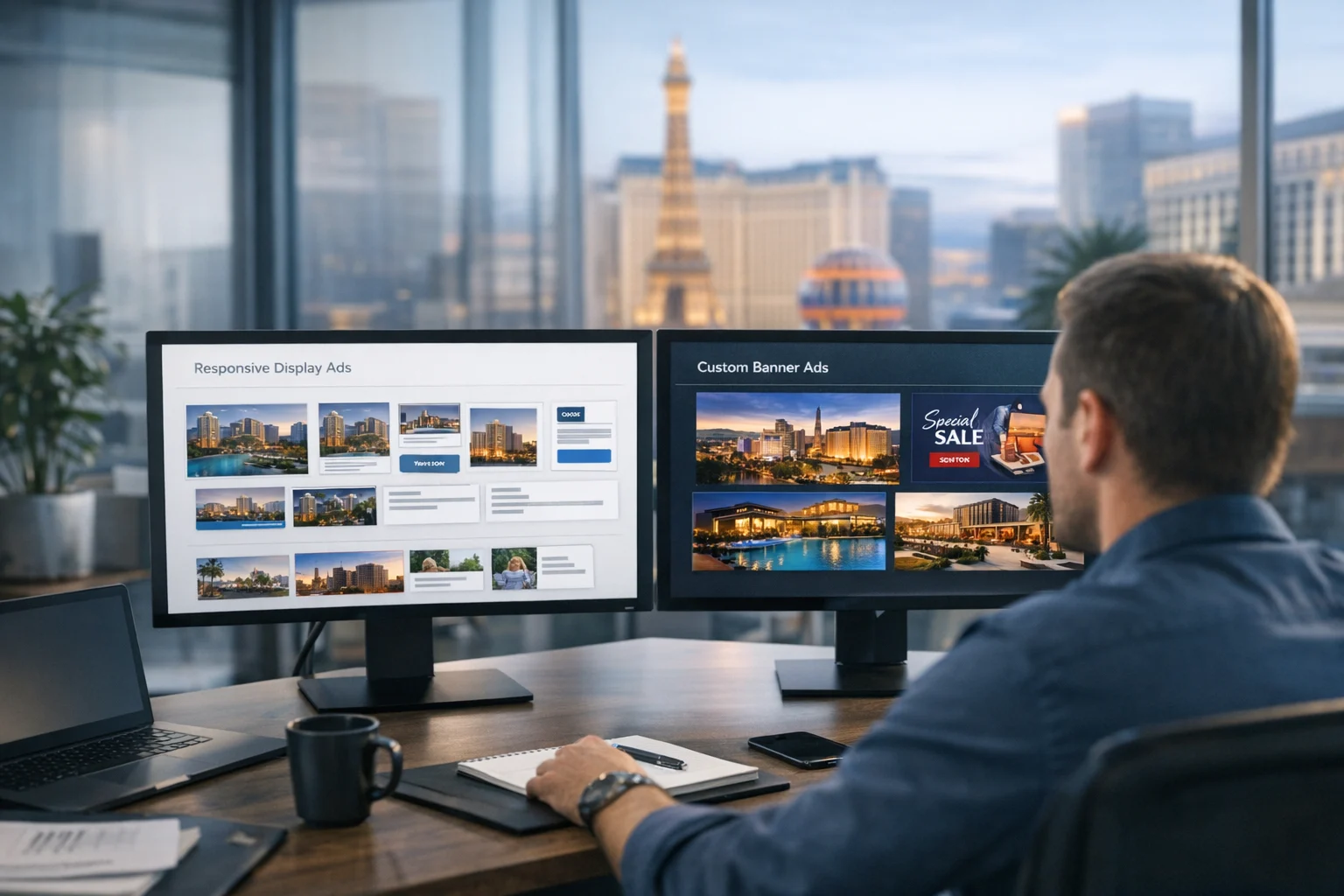
If you're spending money on display advertising, one question comes up fast: should you run responsive display ads or invest in custom banner ads? It's a fair question, and the answer isn't as simple as one format being better than the other. Each serves a different purpose, and the right choice depends on your goals, your market, your creative standards, and how much control you want over the final result.
At SiteLiftMedia, we've seen this play out across local and national campaigns. A Las Vegas service business trying to drive phone calls before a busy summer season doesn't need the same display strategy as a multi-location brand building awareness across several states. The ad format matters, but so does everything around it, from landing page speed and technical SEO to the quality of your offer and the strength of your follow-up process.
Business owners and marketing managers often get sold on the idea that responsive display ads are the modern replacement for banner design, or that custom banners are the only serious option for brands that care about presentation. Neither claim tells the full story. If you want campaigns that generate leads, support brand growth, and hold up in real competition, you need to understand what each format does well and where it can fall short.
What responsive display ads actually are
Responsive display ads are built for scale. Instead of uploading a finished banner in a fixed size, you provide Google with a set of assets. That usually includes headlines, descriptions, logos, images, and sometimes video. Google then mixes and matches those pieces to create ad combinations that fit across a wide range of placements in the Display Network.
That flexibility is the main selling point. You don't have to design every banner size by hand. Google handles the assembly, adjusts layouts automatically, and tests different combinations based on available inventory and performance signals.
For a lot of businesses, that's appealing. You can launch faster, cover more placements, and keep production costs lower than with a fully custom design package. If you're running broad awareness campaigns, remarketing, or lead generation across a wide audience, responsive display ads make it much easier to get into market quickly.
Why advertisers like them
- Speed: campaigns can be built and launched without designing dozens of sizes.
- Reach: the system can fit more inventory across devices and placements.
- Testing: Google can rotate asset combinations and learn which messaging works.
- Efficiency: they reduce creative production time, especially for smaller teams.
They're especially useful when a business needs momentum fast. A Las Vegas company promoting seasonal services, event traffic, tourism-related offers, or summer campaigns usually can't wait weeks for a full creative buildout if the competition is already active.
What custom banner ads bring to the table
Custom banner ads take the opposite approach. Instead of giving the platform pieces to assemble, you create finished ads in specific dimensions. Every image, headline placement, call to action, color block, and visual cue is intentional. You're deciding exactly what the audience sees.
This gives brands much tighter control over presentation. If you care deeply about design consistency, visual hierarchy, typography, and brand feel, custom banners are hard to beat. The strongest ones don't just look polished. They communicate trust in a split second.
That matters more than many advertisers realize. In crowded markets, people make quick judgments. If your ad feels cheap, rushed, or generic, they'll skip past it without thinking twice. A well-made custom banner can instantly signal that your company is established, premium, local, or specialized.
We see this often with higher-value services. Law firms, private medical practices, luxury home services, commercial contractors, and B2B firms in Las Vegas tend to benefit from stronger design control because trust is a major conversion factor. The same is true for brands with strict design standards or regulated messaging requirements.
If you want a better sense of what separates effective creative from forgettable creative, this SiteLiftMedia guide on how to design banner ads that get attention without looking cheap is worth reading.
Where responsive display ads usually win
Responsive display ads are often the better choice when your priority is coverage, efficiency, and continuous testing. That's why they're so common in modern Google Ads accounts.
They adapt to more placements
The Display Network includes an enormous range of inventory. Websites, apps, mobile placements, and different screen sizes all require flexibility. Responsive ads can fit spaces that custom banners may miss if you haven't built the right dimensions. That means more opportunities to show up.
They lower creative friction
If your team has great offers and strong messaging but limited design bandwidth, responsive ads let you move. That's valuable for local businesses and mid-sized companies that need lead generation now, not after a long production process.
For a business juggling SEO, PPC, social media marketing, website maintenance, and day-to-day operations, speed matters. The simple reality is that many companies delay campaigns because the custom ad process stalls. Responsive ads remove that bottleneck.
They can uncover messaging insights
One underrated advantage is testing. Because Google can rotate different headlines, descriptions, and images, you can learn which value propositions resonate. Maybe pricing language works better than quality language. Maybe a direct call to action outperforms a softer awareness message. Maybe images with people perform better than product shots.
Those lessons can later inform your custom banner strategy, landing pages, and even search campaigns.
They often make more sense for remarketing
Remarketing is usually about staying visible, not delivering a design masterpiece. If someone already visited your site, responsive display ads can do a strong job of bringing them back with a consistent reminder and a relevant offer. In those cases, the convenience and scale often outweigh the loss of full visual control.
Where custom banner ads still beat responsive ads
Custom banners earn their keep when the quality of the creative is central to performance. That's common in premium branding campaigns, competitive local markets, and industries where trust is fragile.
Brand control is dramatically better
With responsive display ads, the platform decides how assets are arranged. Sometimes it gets close to your vision. Sometimes it doesn't. Headlines get cropped. Images are reframed. Layouts can feel generic. If your brand relies on a refined look, that lack of control can be frustrating.
Custom banners let you protect the presentation. You know exactly how the message appears, where attention lands, and how the call to action sits in the layout.
They can look more premium
Custom design tends to outperform when visual perception matters. If your business needs to look established, high-end, or highly credible, a polished banner often creates a stronger first impression than an auto-assembled ad.
That makes a difference in Las Vegas, where visual competition is intense. People are exposed to nonstop promotions. Generic creative blends into the background fast. Custom banners can stand out if they're strategically designed, not just dressed up with flashy effects.
Complex offers are easier to communicate
Some campaigns need more careful visual storytelling. Maybe you need to highlight multiple service lines, show before-and-after work, introduce a premium package, or reinforce a very specific call to action. Custom banners give you room to guide the eye and structure the message with intent.
They support broader brand campaigns better
When display advertising is part of a coordinated push that includes custom web design, social media marketing, video, email, and landing pages, custom banners help maintain consistency across channels. That consistency can lift performance, especially for businesses trying to look more established in crowded metro areas.
Performance depends on more than the ad format
One of the biggest mistakes advertisers make is blaming the display format when the real problem sits somewhere else. We've seen underperforming campaigns improve after fixing the landing page, shortening the lead form, tightening geo-targeting, or repairing tracking. The banners didn't suddenly become magical. The system around them got better.
If someone clicks your ad and lands on a slow, cluttered, poorly built page, both responsive and custom ads will struggle. The same goes for websites built on bloated templates that load badly on mobile. If that sounds familiar, this SiteLiftMedia article on why bloated page builders hurt SEO, speed, and sales explains the problem clearly.
Display performance also improves when the rest of your digital foundation is solid:
- Technical SEO: a clean site structure and fast pages support a better landing page experience and stronger conversion behavior.
- Custom web design: trust, clarity, and mobile usability matter after the click.
- Website maintenance: broken forms, outdated plugins, and tracking issues quietly kill lead generation.
- Fast hosting: delays cost conversions, especially on mobile traffic.
- Business website security: users hesitate when a site feels unsafe or behaves oddly.
- Cybersecurity services: secure lead capture matters for both trust and business continuity.
- System administration and server hardening: these become very real issues when campaigns scale and your site starts handling more traffic.
At SiteLiftMedia, this is where agency experience matters. A display ad strategy shouldn't exist in isolation. If you're already investing in Las Vegas SEO, local SEO Las Vegas campaigns, or working with an SEO company Las Vegas, your paid display creative should support the same business goals instead of operating as a disconnected tactic.
How this choice looks for Las Vegas businesses
Las Vegas is a unique advertising environment. It's fast, visually noisy, and highly competitive. Businesses are competing not just with direct local rivals but with aggressive regional and national advertisers entering the market. That changes how display ad creative needs to work.
For local service companies, responsive display ads can be an efficient way to stay visible around the valley, support remarketing, and keep your brand in front of people who already visited your site from search or social traffic. They're especially useful when campaigns need to cover a lot of inventory quickly.
For premium local brands, custom banners often do a better job of building trust. If you're selling high-ticket services in legal, home improvement, healthcare, hospitality, real estate, or luxury experiences, design quality can affect whether a prospect sees you as credible or interchangeable.
There's also the local intent issue. A business trying to rank for terms like web design Las Vegas, Las Vegas SEO, or local SEO Las Vegas shouldn't assume display ads replace those channels. They support them. Strong campaigns usually combine search demand capture, organic visibility, remarketing, and local credibility signals.
That local credibility often includes your Google Business Profile. If your display ads bring people back to search your name and your profile looks weak or inactive, you lose momentum. This is why many of our local campaigns pair paid visibility with efforts to use Google Business Profile posts for local leads.
We've also found that Las Vegas businesses preparing for stronger competition benefit from a full-funnel view. Display ads create awareness and repeat exposure. Search captures intent. Backlink building services and technical SEO strengthen long-term organic visibility. Social media marketing helps reinforce the brand. Secure, fast landing pages turn interest into actual leads.
Budget, production time, and management reality
Budget is usually where the conversation gets real. Responsive display ads are cheaper to produce. That's not controversial. You can get a campaign running with a small set of assets and start gathering data fast.
Custom banner ads cost more because they require design time, revisions, format exports, and sometimes animation or platform-specific variations. If you need a full set of sizes for multiple campaigns, the production workload grows quickly.
That doesn't mean custom is too expensive. It means the return has to justify the added effort. If one strong creative set helps a high-value service business close even a few more quality leads, the math can make sense fast.
Management complexity matters too. Responsive campaigns can be easier to scale, but they still need oversight. Asset quality, audience targeting, exclusions, placement reviews, conversion tracking, and landing page testing all affect results. Custom banners need less layout interpretation by the platform, but they require more front-end design planning.
A lot of businesses pick responsive because it feels simpler. That's reasonable. The risk is assuming simple means automatic. It doesn't. Even the best responsive ad campaign can waste money if targeting is loose or the offer isn't compelling.
A practical way to decide which format fits your campaign
If you're trying to choose between responsive display ads and custom banner ads, ask a few direct questions.
- Do you need speed and scale right now? If yes, responsive is often the smart starting point.
- Is your brand presentation a major part of the sale? If yes, custom banners deserve serious consideration.
- Are you remarketing to warm traffic? Responsive may be enough, especially if the offer is strong.
- Are you launching a premium campaign or entering a crowded market? Custom usually gives you a stronger first impression.
- Do you have tested messaging already? If not, responsive ads can help you learn what angles work before investing heavily in custom design.
- Is your landing page ready? If not, fix that first. Better creative won't rescue a weak page.
Many companies don't need to choose one forever. They need the right format for the right stage of the campaign.
Why a hybrid strategy often works best
In practice, some of the best-performing accounts use both formats. Responsive display ads provide broad reach, flexible placement coverage, and message testing. Custom banner ads handle premium placements, brand campaigns, high-value offers, and design-sensitive audiences.
That gives you both efficiency and control. You can test value propositions with responsive assets, learn what gets clicks and conversions, then turn those insights into polished custom creative. Or you can lead with custom banners for a brand push and let responsive remarketing keep the audience warm afterward.
This is usually the most practical strategy for growing companies. It lets you protect your brand where it matters while still taking advantage of the scale and adaptability built into modern display platforms.
It's also a better fit for businesses that aren't treating ads as a standalone expense. If you're investing in web design Las Vegas services, technical SEO improvements, content, search campaigns, or stronger business website security, your display ads should work as part of that ecosystem.
What to expect from an agency that knows the difference
A capable agency shouldn't push one format by default. They should look at your market, your goals, your creative standards, and the quality of your post-click experience.
That means asking things like:
- What action do we want from the traffic?
- How important is strict visual brand control?
- What placements and audience segments matter most?
- Is the campaign focused on awareness, remarketing, or direct lead generation?
- Do we have a fast, secure landing page that can convert the traffic?
- Are we tracking calls, forms, and actual lead quality?
At SiteLiftMedia, we look at display campaigns through a wider growth lens. That includes design quality, conversion paths, local search visibility, technical SEO, hosting performance, and the security side too many agencies ignore until a site has problems. If you're running paid traffic into an unstable or under-maintained site, penetration testing, cybersecurity services, system administration, and server hardening start becoming business issues, not just IT issues.
If you want help deciding whether responsive display ads, custom banner ads, or a hybrid campaign makes more sense for your business, SiteLiftMedia can map it out with you. Bring the market, the goals, and the landing pages, and we'll help you choose the format that gives your campaign the best chance to perform.
Photo Gallery