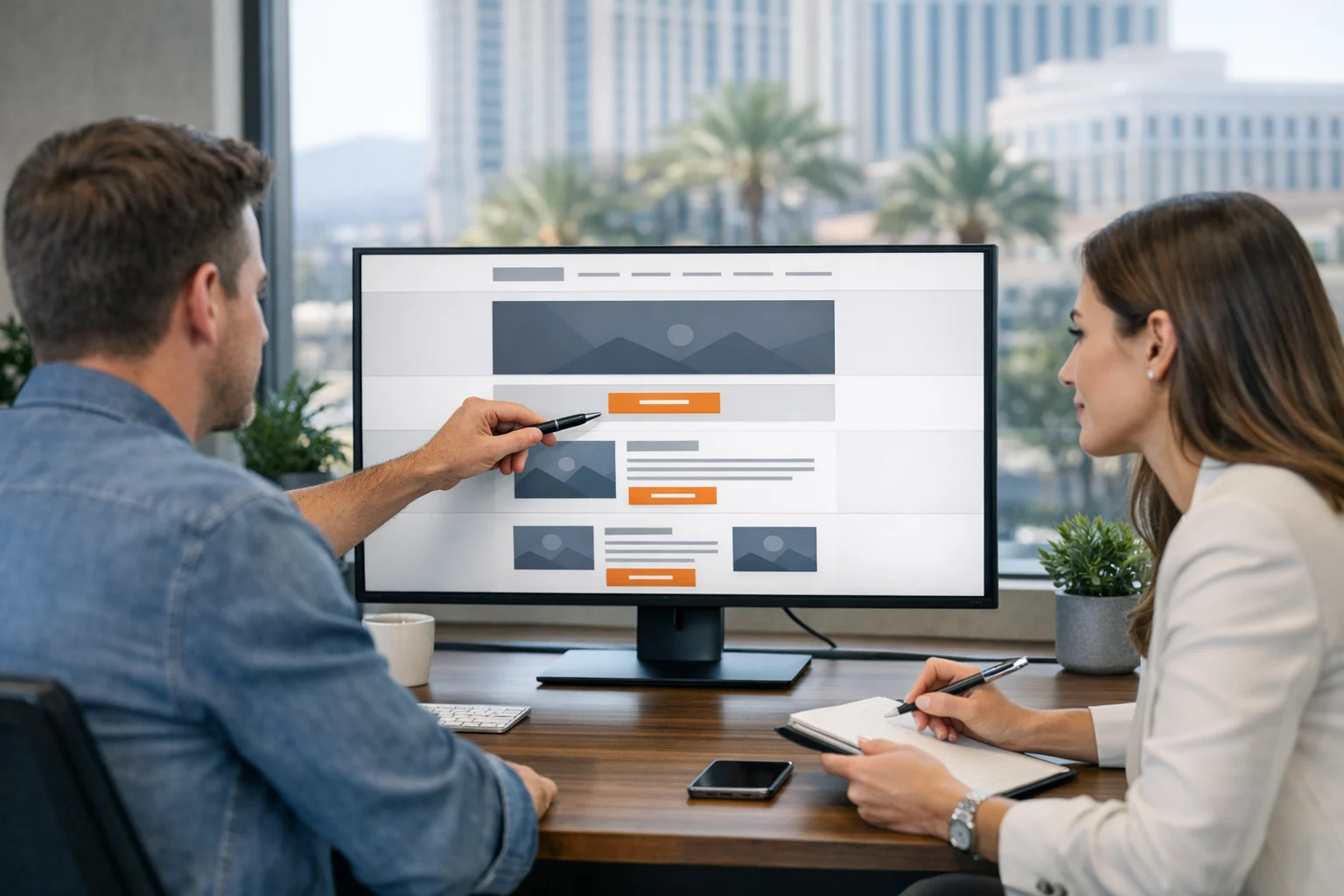
Getting traffic is expensive. Whether it comes from Las Vegas SEO, Google Ads, social media marketing, email campaigns, or referral traffic, every visit costs something, time, budget, effort, or all three. The problem is that many business websites still treat design like decoration instead of what it really is, a sales tool.
At SiteLiftMedia, we see this all the time. A company invests in search visibility, content, paid traffic, and even backlink building services, but the website itself is not built to convert. It looks fine. It may even rank well. Yet the calls do not increase, the forms stay quiet, and sales teams complain that lead flow is inconsistent. That gap usually comes down to design decisions.
Strong web design does more than make a brand look polished. It guides visitors, answers objections, reduces friction, builds trust, and moves people toward action. That matters for nationwide brands, and it matters even more in competitive local markets like Las Vegas, where people compare providers quickly and make decisions on mobile devices in real time.
If someone searches for web design Las Vegas, SEO company Las Vegas, or local SEO Las Vegas, they are not looking for abstract creativity. They want a business that feels credible, easy to work with, and ready to solve a problem. The same applies whether you are a law firm, contractor, med spa, home service company, B2B provider, or multi location service business. Design has to support conversion from the first second.
Here are the web design tactics that consistently help businesses turn traffic into leads.
Start with buyer intent, not homepage aesthetics
One of the most common mistakes in web design is starting with visuals before strategy. Colors, animations, and trendy layouts can be useful, but they should never come first. The first question should be simple, what does this visitor need to see to take the next step?
That changes everything. A visitor from branded search behaves differently from someone landing on a service page through non branded local SEO. A person clicking from PPC may be ready to call now. A visitor from a blog post may still be comparing options. Good conversion design matches those intent levels.
For service businesses, the most effective websites usually make these points clear right away:
- What you do
- Who you help
- Where you work
- Why you are credible
- What the next step is
When those answers are hidden behind vague headlines or clever branding language, conversion rates suffer. We have found that direct messaging almost always beats ambiguity. Visitors should never have to interpret your value proposition.
That is especially important for local and regional search. People looking for a Las Vegas provider want immediate confirmation that they are in the right place. If you serve Nevada and national markets, your messaging should acknowledge both without feeling cluttered.
Make the first screen do more work
The top section of a page still carries the most weight. Not because visitors never scroll, but because first impressions shape whether they continue. The first screen has one job, keep the right visitor moving.
That means your hero section should include a clear headline, a specific supporting statement, and a strong call to action. Not three competing offers. Not a giant stock photo that pushes useful information below the fold. Not a slider with rotating messages no one reads.
For example, a high performing service homepage might include:
- A headline tied to the service outcome
- A short subhead that explains the process or differentiator
- A primary call to action such as request a quote or book a consultation
- A secondary action such as call now or view services
- Trust cues like reviews, certifications, years in business, or client count
In practice, this creates a more decisive experience. A visitor should not have to hunt for contact options or guess whether you serve their location. This is one reason custom web design tends to outperform generic templates. It lets the first screen reflect the actual sales priorities of the business instead of forcing the business into a prebuilt layout.
Reduce friction in navigation and page structure
Traffic drops off when people feel lost. That sounds obvious, but a surprising number of websites still overload navigation with too many options, unclear labels, or buried service pages. Conversion friendly design simplifies choice.
Your main navigation should reflect how people buy, not how your company is organized internally. Most websites benefit from a lean top menu with core services, industries if relevant, service areas, about, and contact. Anything extra can live in the footer or secondary navigation.
Page structure matters too. Long pages can convert well when they are easy to scan. Use visual hierarchy to guide the eye. Strong section headings, short paragraphs, bullet points, trust signals, and repeated calls to action all help visitors process information without fatigue.
It also helps to keep a consistent pattern across service pages. When users know where to find benefits, process details, FAQs, and forms, they move through the site with less hesitation. This is especially helpful for companies with multiple services or multiple target markets.
Clean structure does not just improve usability. It supports technical SEO and crawlability as well. Search engines prefer sites that are logically organized, internally connected, and easy to interpret. Better architecture helps rankings and conversions, which is exactly where design and SEO should work together.
Build service pages for lead intent, not just rankings
A lot of businesses create service pages because they know they need them for search. That is fine as a starting point, but ranking alone is not the goal. The page has to persuade.
Think about the difference between a thin page targeting a phrase like web design Las Vegas and a page that actually helps a business owner decide whether to contact you. The second page explains outcomes, outlines the process, answers practical concerns, highlights proof, and offers a clear path forward.
Strong service pages usually include:
- A specific promise tied to the service
- Problems the service solves
- Who it is best for
- A simple explanation of how the engagement works
- Proof points such as results, testimonials, examples, or certifications
- A call to action placed in more than one spot
For local search, location relevance should be woven in naturally. If you serve Las Vegas, say so in a useful way. Mention the market, the competition level, the importance of local visibility, and the buyer behavior you see in that region. That reads much better than awkwardly repeating city names.
If you are planning a refresh, this guide to a conversion focused website redesign in Las Vegas covers the bigger structural decisions that often separate a good looking site from one that produces steady leads.
Use calls to action that match decision stage
Not every visitor is ready to buy on the spot, so not every call to action should ask for the same level of commitment. This is where many websites leave leads on the table.
If the only option is a high commitment request such as schedule a full consultation, you will lose visitors who are interested but not ready. If the only option is a soft CTA, you may slow down people who were prepared to contact you immediately.
High converting websites usually balance primary and secondary CTAs. A few common examples:
- Primary: Request a quote, book a consultation, call now
- Secondary: See pricing, view portfolio, ask a question, get an audit
- Low friction: Download a checklist, sign up for updates, use a calculator
The key is clarity. Buttons should tell people what happens next. Generic labels like submit and learn more tend to underperform because they create uncertainty. Stronger CTA copy reduces hesitation and lifts response rates. SiteLiftMedia has seen this repeatedly on service pages where traffic was healthy but action rates were weak.
If you want a deeper look at this area, stronger calls to action can make a measurable difference with surprisingly small design changes.
Fix forms before buying more traffic
Forms are often the last step between interest and lead, and they are one of the easiest places to lose conversions. Businesses spend thousands increasing traffic while keeping a form that creates friction for no reason.
A lead form should feel easy, fast, and low risk. The longer it is, the more every field needs to justify itself. If your sales team does not truly need a data point up front, do not ask for it. You can always qualify later.
There are a few form tactics that consistently improve performance:
- Keep required fields to a minimum
- Group fields logically and label them clearly
- Show reassurance near the form, such as response time or privacy language
- Use a button label that reflects the value of the action
- Make the form visually prominent without overwhelming the page
For service businesses, context matters too. A form next to a vague block of text rarely performs as well as a form placed after clear service benefits, trust signals, and a brief explanation of what happens after submission.
This is one area where design details have a direct revenue impact. If your site gets solid traffic but weak inquiry volume, the form is one of the first places to investigate. SiteLiftMedia has a more detailed breakdown of how better form design turns more visitors into leads if this is a current pain point.
Design for mobile conversion first, not as an afterthought
Mobile traffic dominates in many industries, especially local services. In Las Vegas, where users often search on the go and take quick action, mobile design can make or break lead generation. Yet many websites are still designed on desktop first, then simply compressed for smaller screens.
That approach usually creates problems. Buttons end up too close together. Text blocks get long and tiring. Forms feel tedious. Key trust signals disappear. Phone numbers are hard to tap. Page speed often suffers.
Mobile conversion design is different. It prioritizes simplicity, tap friendly layouts, sticky contact options when appropriate, condensed but clear messaging, and fast access to the next step. The best mobile experiences remove anything that does not help the visitor act.
Some of the most effective mobile tactics include:
- Click to call buttons near the top of the page
- Shorter sections with strong visual hierarchy
- Reduced menu complexity
- Fast loading images and optimized scripts
- Forms designed for thumbs, not a mouse
If your analytics show strong mobile traffic and low mobile conversions, that is not just an SEO issue. It is a design issue. Responsive layouts alone are not enough. They have to be built around how people actually behave on phones.
Use trust signals where people hesitate
Trust is not a separate page on your website. It should show up exactly where people feel uncertain.
That means testimonials near service claims, certifications near technical services, guarantees near pricing concerns, and location signals where users may wonder whether you serve their area. It also means showing real proof instead of leaning on broad claims like best in class or trusted by many.
For example, if you offer web design, SEO, PPC, app development, or cybersecurity services, visitors may have different concerns. One prospect wants to know whether you can generate leads. Another wants to know whether your team can protect sensitive systems. Another wants to know whether your process will create delays. Trust content should answer those specific worries.
Useful trust elements include:
- Client testimonials with detail, not just names
- Review snippets from Google or relevant platforms
- Case study results where available
- Years in business or project count
- Industry experience and certifications
- Clear service area language for local confidence
For local search especially, credibility affects conversion as much as rankings. A business can win the click through Las Vegas SEO and still lose the lead if the landing page feels generic or unproven.
Speed, technical SEO, and conversion are tied together
Some teams still separate design from SEO and SEO from conversion. In practice, they overlap constantly.
A slow website frustrates users and weakens engagement. Poor layout shift makes pages feel unreliable. Broken internal linking hurts crawl efficiency and user flow. Weak heading structure confuses both visitors and search engines. Thin location pages may not rank, and even if they do, they may not convert.
This is where technical SEO supports better design outcomes. Compression, caching, script control, image optimization, schema, crawlable navigation, and clean page structure all help create a site that is easier to find and easier to use.
Businesses often focus heavily on top of funnel visibility through content and backlink building services, then ignore the performance of the destination pages. That is a missed opportunity. If a page ranks but loads slowly, looks cluttered, and lacks a clear conversion path, traffic quality will look worse than it really is.
For any company investing in local SEO Las Vegas or broader nationwide search growth, conversion design should be reviewed alongside SEO performance. Rankings without action are only half a win.
Security and reliability influence lead generation more than most teams realize
People do not usually think of cybersecurity services and server administration as conversion topics, but they absolutely are. A website that feels unsafe, loads with warnings, or breaks under traffic spikes will lose leads fast.
Security also affects perception. If users see browser trust issues, suspicious redirects, or broken forms, they may never come back. For service businesses that handle contact requests, appointment bookings, or customer data, business website security is part of the buying experience.
There is also an operational side. Good website maintenance, system administration, and server hardening help keep lead paths open. Forms need to deliver reliably. Tracking needs to stay intact. CMS updates should not break key pages. SSL issues should be resolved before they affect trust or rankings. If your business handles sensitive workflows, periodic penetration testing can help identify weaknesses before they become real problems.
SiteLiftMedia works with companies that need both growth and protection. That combination matters. A website should not only attract traffic through strong design and SEO. It should stay stable, secure, and conversion ready month after month.
Match post click design to the traffic source
Not all traffic arrives with the same expectations. Someone coming from a branded Google search is different from someone clicking a social ad or a PPC landing page. If the page experience does not match the promise that got the click, conversion rates usually drop.
For example, if a paid campaign offers a free audit, the landing page should center that offer clearly. If social media marketing drives visitors to a service page, that page should quickly reinforce the value proposition from the ad or post. If local organic traffic lands on a city or service page, that page should confirm local relevance and next steps within seconds.
This is one reason customized landing pages outperform generic traffic routing. Different audiences need different levels of explanation, proof, and commitment. A CEO researching an agency partner may want strategic clarity. A marketing manager may want process details and deliverables. A local business owner may just want to know whether you can get the phone ringing.
Designing pages around source intent lets you keep messaging tighter and CTAs more relevant, which usually means better lead quality as well.
Use data to refine what the design is already telling you
You do not need to guess your way into better conversions. Good design decisions can be validated. Look at heatmaps, scroll depth, form abandonment, click paths, mobile drop off, and landing page conversion rates. Pair that with call tracking and CRM feedback so you can tell the difference between more leads and better leads.
Often the highest impact changes are not dramatic. They are practical. Rewriting a headline. Moving trust signals higher. Shortening a form. Improving mobile spacing. Reordering service sections. Replacing weak images. Adding a clearer CTA after a pricing explanation.
These improvements tend to compound. A cleaner page with stronger messaging and fewer points of friction can turn the same amount of traffic into a much healthier pipeline. That is why website refresh projects are often a smart move in annual planning and Q1 growth strategies. You do not always need more traffic first. Sometimes you need your existing traffic to work harder.
If your website is attracting visitors but not producing the leads it should, SiteLiftMedia can audit the experience, identify the weak points, and help you build a conversion focused site that supports SEO, paid traffic, mobile users, and long term growth. If you are in Las Vegas, or serving customers nationwide from Nevada, reach out and take a closer look at where your current design is helping and where it is quietly costing you leads.
Photo Gallery