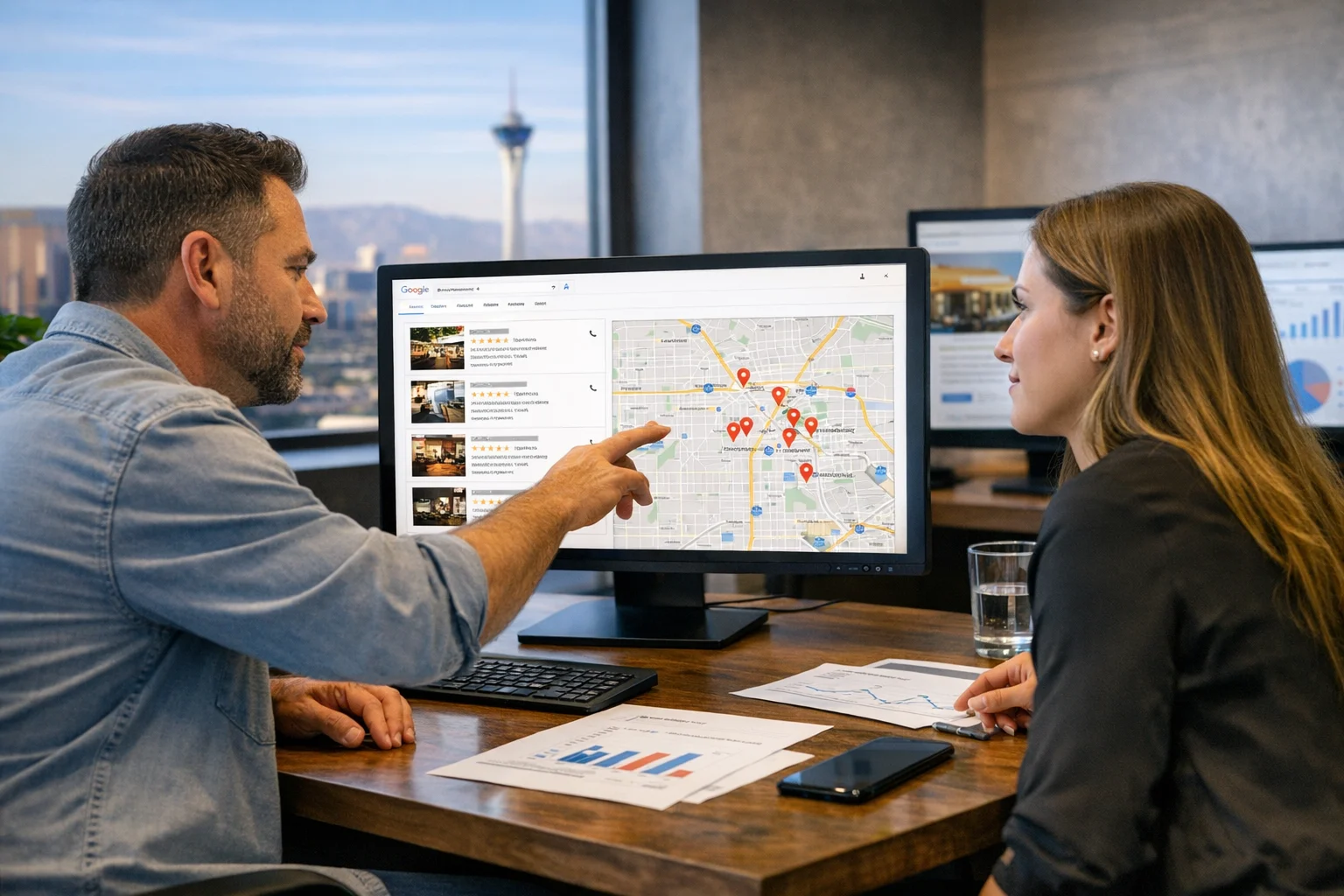
If you have ever searched for a service on Google and noticed the same three businesses showing up in Maps while others seem invisible, you are not imagining it. Local rankings are not evenly distributed, and they are definitely not random. Some businesses earn strong visibility in the map pack again and again. Others stay buried, even when they offer great service and have been around for years.
At SiteLiftMedia, we see this pattern all the time with both local companies and multi location brands. A business owner may assume Google is favoring a competitor for no reason, but when you dig in, there is almost always a clear explanation. Sometimes it is a weak Google Business Profile. Sometimes it is poor category targeting, thin website content, weak review signals, or technical problems that quietly undermine trust. In more competitive markets like Las Vegas, those weaknesses stand out even more.
If you are trying to improve Las Vegas SEO, strengthen local SEO Las Vegas performance, or figure out why your business is not getting calls from Maps, the answer usually comes down to a handful of practical factors. The businesses that rank well tend to build a stronger local footprint across their profile, website, reputation, and technical foundation. The ones that do not are often missing one or more of those pieces.
Maps rankings are built on relevance, distance, and prominence
Google has never hidden the broad framework behind local rankings. In simple terms, it looks at relevance, distance, and prominence. That sounds straightforward, but most businesses underestimate how much work it takes to prove all three.
Relevance is how well your business matches the search. If someone searches for emergency plumber, Google wants to show businesses clearly associated with that service. If your profile says general contractor, your homepage talks vaguely about home solutions, and your service pages are thin, Google has less confidence in what you actually do.
Distance is how close your business is to the searcher or the location named in the search. This is why a great company can still struggle to appear citywide. A business in Henderson may not show strongly for a search happening near Summerlin unless the rest of its signals are very strong.
Prominence is where many rankings are won or lost. This includes your reviews, brand mentions, backlinks, website authority, local citations, and how established your business appears online. Prominence is often the deciding factor when multiple businesses are equally close and equally relevant.
In a high competition market, especially one as active as Las Vegas, a business usually needs to perform well in all three areas. A weak website or neglected profile might not matter as much in a small town. In Las Vegas, it often matters right away.
Your Google Business Profile carries more weight than most companies realize
A surprising number of businesses want more visibility in Maps but have not fully built out the profile that powers those results. Their Google Business Profile may be verified, but that is not the same as optimized.
The businesses that rank consistently tend to have a profile that looks active, complete, and trustworthy. That means:
- Accurate business name, address, phone number, and website
- The right primary category and supporting secondary categories
- Detailed services and business description
- Updated hours, including holidays
- Real photos of the team, office, work, and branding
- Frequent reviews and owner responses
- Relevant service areas where appropriate
- Ongoing profile activity such as posts, photos, and updates
Businesses that do not rank often have category mismatches, outdated hours, old phone numbers, no service detail, or no visual proof that the business is active. Those gaps make it harder for Google to trust the listing, and harder for searchers to click when they do see it.
We have worked with companies that had solid websites and good service, but their profile had the wrong primary category for years. Once that was fixed and aligned with the website, they started seeing traction. If you suspect profile issues are holding you back, this guide on Google Business Profile mistakes that hurt local rankings is worth reviewing.
Your website still matters for Maps, even if the click happens inside Google
Many business owners assume Maps rankings are separate from website SEO. They are not. Google uses your website to validate what your profile claims. If your website is thin, outdated, slow, or confusing, your map visibility can suffer.
This is one reason local SEO and technical SEO belong in the same conversation. A business might have a decent profile, but if its site has weak service pages, missing city relevance, duplicate content, or crawl issues, Google has less confidence in the business.
Strong local websites usually have:
- Dedicated service pages that clearly explain what the company offers
- Location aware content that supports city or regional search intent
- Clean navigation and mobile friendly layout
- Fast load times and solid Core Web Vitals
- Proper page titles, headings, internal linking, and schema where useful
- Contact information that matches the business profile exactly
This is where good web design Las Vegas projects often support search performance far beyond aesthetics. A site built purely for looks may not help rankings much. A site built with custom web design, user flow, local relevance, and technical SEO in mind gives Google more reasons to trust the business.
At SiteLiftMedia, we regularly find businesses trying to rank in Maps with websites that still use broad, generic language like we help clients succeed. That does not tell Google enough. A better approach is precise content that explains services, industries, service areas, and what makes the company different.
If you want more examples of what to look for, our article on SEO audit tips for businesses that want more leads breaks down the kinds of problems that quietly hold sites back.
Reviews influence visibility, clicks, and trust
Reviews are not just a conversion factor. They are a ranking signal and a credibility signal. Google wants to show businesses that people clearly value, and review patterns help it estimate that.
The businesses that rank in Maps usually have a review profile that looks real and steady. They are not waiting six months between reviews. They are asking consistently, responding professionally, and earning feedback that mentions actual services and locations.
What helps most:
- A steady flow of new reviews instead of long periods of silence
- Detailed reviews that mention the type of work performed
- Owner responses that sound human and specific
- Strong average rating without obvious manipulation
- Reviews across Google and other trusted platforms
What hurts:
- Burst patterns that look unnatural
- Many low quality reviews with no service detail
- No responses from the business
- Frequent complaints about the same issue
- Review gating or risky tactics that can trigger moderation problems
In local markets, reputation often becomes the edge when several businesses are otherwise similar. We have seen companies move into stronger map positions after improving review acquisition and response habits, even before major website changes were finished. If you want to go deeper on this, read how reputation signals improve local search rankings.
Citations and business consistency still matter
There was a time when local SEO campaigns leaned heavily on directory submissions and citation cleanup. That alone will not carry a business anymore, but consistency is still important. When Google sees conflicting business data across the web, confidence drops.
This is a common reason some businesses do not rank as well as they should. Their Google profile may list one phone number, their website another, and older directories may show a previous address. Add in duplicate listings, outdated service areas, or slightly different branding, and the local footprint starts to look messy.
Businesses that rank well often have cleaner business data across major directories, industry sites, chamber listings, and local references. It is not glamorous work, but it removes friction from the trust equation.
For service area businesses, this gets more complicated. You still need consistency, but you also need to avoid creating fake location signals. A business cannot simply build twenty city pages, rent a mailbox, and expect strong Maps visibility across a metro area. Google has gotten much better at spotting weak location intent.
Location and market competition change the game
Some businesses do almost everything right and still struggle in Maps because they are in a difficult category or a crowded service area. This is especially true in Las Vegas, where legal, home services, hospitality, medical, and digital marketing categories can be highly competitive.
If you are trying to rank for searches tied to Las Vegas SEO, SEO company Las Vegas, or other saturated terms, you are not just competing with nearby businesses. You are competing with established brands that have stronger authority, deeper content, more reviews, better backlinks, and a longer history of online prominence.
That does not mean you cannot break through. It means your expectations need to match the market. A newer company in a competitive area may need to focus on narrower service terms, tighter location relevance, and reputation growth before it can challenge stronger players for broad local searches.
The same rule applies nationwide. A business in a smaller city might rank with a decent profile and a clean site. In Las Vegas, Phoenix, Dallas, or Miami, that same setup may barely move the needle. Competition determines how complete your strategy needs to be.
Content expansion helps Google understand what you actually do
One of the most common gaps we see is a lack of content depth. Many businesses have a homepage, an about page, and a contact page, then wonder why Google does not connect them to more specific searches. That limits both organic and map visibility because the business never fully establishes topical relevance.
Businesses that rank better often have a wider content footprint around their services. That can include:
- Detailed service pages
- City or service area pages where legitimate
- Helpful FAQs
- Case studies and project examples
- Articles tied to common customer questions
- Support content around seasonal needs, spring marketing pushes, and redesign planning
Service content is especially useful because it gives Google a stronger map of your capabilities. A plumbing company should not just say plumbing. It should explain water heater replacement, leak detection, emergency repair, drain cleaning, and commercial plumbing. The same idea applies to agencies. If you offer PPC, social media marketing, website maintenance, or backlink building services, those deserve their own clear pages.
For companies trying to grow local relevance, we often recommend service articles that support both user education and keyword targeting. This guide on why service articles help Las Vegas businesses rank shows how that content strengthens visibility over time.
User engagement sends real signals
Google does not rely on one factor. It also watches how people interact with listings. If a business gets seen but rarely earns clicks, calls, direction requests, or website visits, that can be a sign the listing is not compelling.
The strongest map listings usually do a few things well:
- They have a recognizable, professional brand presence
- Their review count and rating stand out
- Their photos feel current and credible
- Their business description matches what searchers want
- Their website looks trustworthy once users click through
This is where design and messaging matter more than people expect. A business may win the impression but lose the customer if the profile looks neglected or the site feels dated. That is one reason web design, local SEO, and conversion strategy should support each other instead of being treated like separate projects.
Technical trust can quietly help or hurt local visibility
Most local ranking conversations focus on content and profiles, but there is another layer that often gets ignored, site health and infrastructure. If your website has crawl issues, malware warnings, broken pages, unstable hosting, or major speed problems, your ability to rank and convert suffers.
We have seen businesses invest in ads and SEO while running on shaky hosting, outdated plugins, or neglected CMS installations. When that leads to downtime or security issues, performance drops fast. Google does not want to send traffic to a bad destination, and users certainly do not want to land on one.
This is where technical support matters. Good website maintenance, system administration, server hardening, and business website security are not just IT concerns. They protect the marketing asset your rankings depend on. In more advanced cases, cybersecurity services and penetration testing can help identify deeper vulnerabilities before they turn into public problems.
For companies planning a redesign or infrastructure cleanup, this is the right time to align marketing goals with technical stability. A polished local presence is easier to build when the platform underneath it is secure and fast.
Spam and weak tactics still distort local results, but not forever
Business owners often notice low quality competitors ranking in Maps and assume quality does not matter. Sometimes spam does slip through. Keyword stuffed business names, fake addresses, fake reviews, and lead gen listings can still appear in some categories.
But those wins are often fragile. Google updates local results constantly, and spammy listings tend to get filtered, suspended, or replaced. Businesses that rely on shortcuts can disappear overnight.
The safer long term play is building a legitimate local presence that can survive scrutiny. That means real branding, real reviews, real service proof, a strong website, and consistent business data. If a competitor is gaming Maps, there may be ways to report it, but the bigger opportunity is often strengthening your own footprint so you are less vulnerable to short term noise.
What businesses that rank in Maps usually do better
After enough audits, the patterns become obvious. The companies that show up most often are usually doing several practical things better than the companies below them:
- They picked accurate categories and service definitions
- They built a complete, active Google Business Profile
- They maintain consistent NAP data across the web
- They earn reviews steadily and respond to them
- They have stronger local content and service page depth
- They invest in technical SEO and site performance
- They support visibility with quality links, mentions, and PR where relevant
- They keep their website secure, maintained, and conversion friendly
The companies that do not rank often focus too narrowly on one piece. They may buy backlink building services without fixing their site. They may post on social media marketing channels while ignoring reviews. They may pay for traffic while their profile is incomplete. Local visibility works best when the business presents a clear, consistent signal everywhere Google looks.
If your business is not ranking, start with the gaps that matter most
You do not need to guess your way through this. Start with the profile, the website, the reviews, and the consistency of your business data. Compare your digital footprint against the businesses ranking above you. In most cases, the differences are visible once you know where to look.
For Las Vegas businesses, that process tends to reveal competitive gaps quickly because the market is active and search intent is strong. For nationwide brands and regional service providers, the same framework still applies, just with more location nuance.
If you want a clear view of why your business is missing from Maps or underperforming in local search, SiteLiftMedia can audit the profile, website, technical setup, and local SEO signals shaping visibility. Whether you need stronger Las Vegas SEO, better custom web design, website maintenance, cybersecurity services, or a more complete local growth strategy, we can help you fix what is holding rankings back and build from there. Reach out to SiteLiftMedia if you want a direct look at what Google is seeing and where your local visibility is breaking down.
Photo Gallery