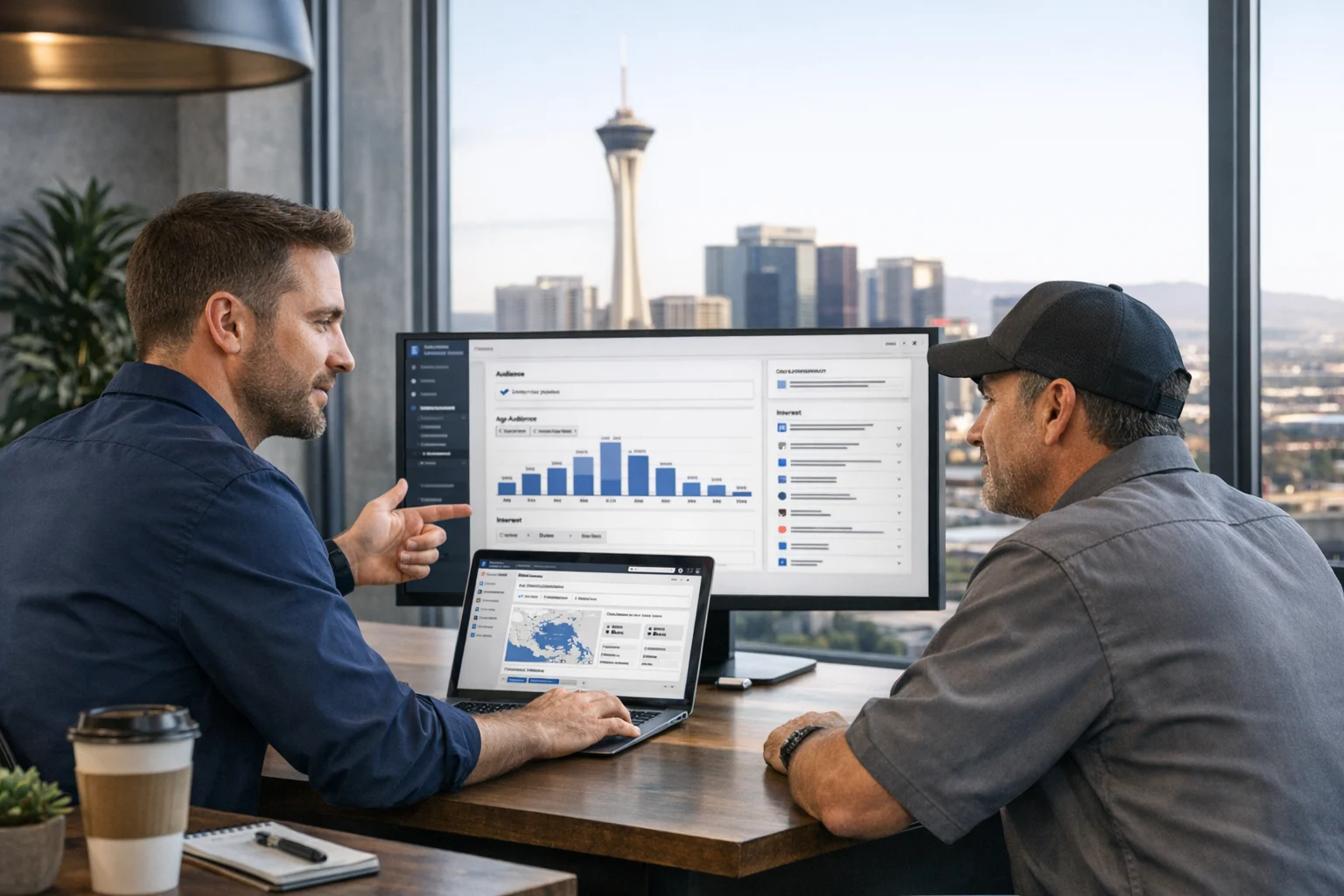
Facebook Ads can still be one of the fastest ways for a local business to get in front of the right people, but only if the audience setup makes sense. That’s where many campaigns fall apart. Business owners hear terms like custom audience, lookalike, retargeting, broad targeting, and interest stack, then end up staring at a dashboard full of settings that don’t clearly connect to leads, calls, or booked jobs.
For local businesses and service brands, audience strategy matters more than most people realize. The right offer with the wrong audience will not perform. Strong creative with sloppy targeting will waste budget. In competitive markets like Las Vegas, where businesses are fighting for visibility across search, social media marketing, maps, and paid media, the audience layer can be the difference between a profitable campaign and a frustrating one.
At SiteLiftMedia, we work with companies that need marketing to drive real business outcomes, not vanity metrics. That includes lead generation campaigns for home services, healthcare, legal, hospitality, B2B service brands, and growth-focused local companies. Whether you’re trying to reach homeowners in Summerlin, attract new clients across the Las Vegas valley, or scale nationwide from a Nevada base, understanding how Facebook Ads audiences work gives you a much better shot at profitable growth.
Why audience strategy matters so much in Facebook Ads
Facebook and Instagram ads are interruption-based platforms. People are not searching the way they do on Google. They’re scrolling. That means your campaign has to do two things at once: grab attention and reach the right people. If either piece misses, performance drops fast.
For service brands, this matters even more because most people do not need your service every day. A roofing company, med spa, law firm, plumber, custom web design agency, or cybersecurity services provider is usually selling something tied to timing, trust, and local relevance. You do not just need clicks. You need to get in front of people who are likely to care now or soon.
It’s also why Facebook Ads should not be treated as isolated media buying. Audience quality depends on the rest of your marketing system. Your site speed, landing page message, business website security, CRM follow-up, and tracking accuracy all affect what happens after the click. A lot of campaigns underperform because the targeting gets blamed for problems caused by a weak funnel.
If you’re already investing in Las Vegas SEO, local SEO Las Vegas campaigns, or Google Ads, Facebook can be a strong supporting channel. It can build awareness earlier, retarget visitors who did not convert, and stay in front of past leads until they’re ready. We’ve covered the broader strategy in how to combine PPC and SEO for better long term growth, and Facebook audience planning fits directly into that bigger picture.
The main Facebook Ads audience types explained
Meta gives advertisers a few core ways to define who sees an ad. Each one has its place, but they work best when matched to the right stage of the buyer journey.
Core audiences
Core audiences are built from native targeting options inside Meta Ads Manager. This includes location, age, gender, interests, behaviors, language, and demographic signals. For local businesses, location is usually the starting point. A pool company in Las Vegas may want to target homeowners within specific zip codes, while a med spa might target women in a certain age range across Las Vegas, Henderson, and Summerlin.
Interest targeting still has value, but it is not magic. If you stack too many interests together, you can make the audience too narrow. If you target broad interests with no clear local fit, you can attract low-intent traffic. Core audiences are usually best for awareness and top-of-funnel campaigns when you do not yet have enough data for custom or lookalike audiences.
Custom audiences
Custom audiences are often where Facebook Ads start to become much more profitable. These are audiences built from people who already know your brand in some way. Common examples include:
- Website visitors
- People who visited a specific service page
- Video viewers
- Instagram engagers
- Facebook page engagers
- Past customers
- Email lists and CRM contacts
- People who opened but did not submit a lead form
If someone already visited your website or interacted with your social content, they are usually much warmer than a cold audience. A retargeting campaign to recent site visitors often outperforms cold traffic campaigns because the brand recognition is already there.
This is why the website matters so much. If your tracking is broken, your custom audiences are incomplete. If your page loads slowly, fewer visitors reach the event trigger. If people hit a weak landing page and bounce, the retargeting pool gets filled with poor-quality traffic. Good audience strategy starts before the ad click. That’s one reason businesses working on web design Las Vegas projects, website maintenance, and fast hosting often see stronger paid media results afterward.
Lookalike audiences
Lookalikes let Meta find new people who resemble an existing source audience. If you upload a strong customer list or build a source audience from qualified leads, Meta can model similar users and expand your reach.
Lookalikes can work very well for service brands, but the source matters. A lookalike based on all website visitors is usually weaker than a lookalike based on booked consultations, closed customers, or high-quality leads. Garbage in, garbage out applies here.
For local brands, size and geography matter too. If you’re targeting a tight local area, your lookalike audience may need to be tested carefully against broad targeting and strong retargeting. In some cases, especially in a city like Las Vegas with distinct neighborhoods and tourism-driven audience overlap, a broad audience with good creative can outperform a poorly built lookalike.
Advantage and audience expansion features
Meta increasingly pushes automated audience expansion through its Advantage features. These tools can help, but they should not replace strategy. They work best when your campaign objective, pixel data, creative, and conversion events are clean.
For a mature account with solid lead quality data, broader algorithmic targeting can perform well. For a newer account, or a local service brand with limited data, too much automation too early can send spend into the wrong pockets. There’s a real difference between giving Meta room to optimize and giving it no guardrails at all.
How local businesses should think about audience stages
One of the easiest ways to make audience strategy more practical is to separate it by funnel stage. Instead of asking, “Who should we target?” ask, “Who are we trying to move one step closer to action?”
Cold audiences
These people have not interacted with your brand yet. They may fit your local market and your ideal customer profile, but they do not know you. Cold audiences usually include:
- Interest-based audiences
- Broad local audiences
- Lookalikes from strong customer data
For cold traffic, your ad should focus on relevance and credibility. Hard-sell messages often fall flat here. A better approach is to lead with a clear problem, a strong local promise, or an offer tied to a real need. A Las Vegas HVAC company might run seasonal service messaging ahead of summer. A law office may lead with a free consultation. A medical practice might use educational content to build trust first.
Warm audiences
Warm audiences know your brand at least a little. They watched part of a video, engaged with your Instagram, visited your site, or clicked an earlier ad. They’re not ready to be treated like a stranger, and they’re not ready to be treated like a customer either.
This is a strong place for proof. Reviews, before-and-after examples, case studies, FAQs, and local trust signals tend to do well. If someone visited your service page but did not convert, your next ad should answer the objections they likely had. Price uncertainty, trust concerns, timing questions, or unclear scope often stop conversions. Warm audience campaigns should address those directly.
Hot audiences
Hot audiences are people closest to action. They may have filled out part of a form, returned to your pricing page, or already contacted your business. For these groups, you can use more direct, conversion-focused messaging.
This audience is often small, but it is usually where some of the highest ROI lives. A simple retargeting sequence that follows up with testimonials, urgency, and a clear call to book can lift lead volume without increasing top-of-funnel spend.
Audience examples for common service brands
The best audience setup depends on the business model. Here are a few real-world examples of how local and service brands can think about it.
Home services
A plumber, electrician, roofer, landscaper, or HVAC company usually benefits from a mix of local broad targeting and retargeting. Interests can help at the awareness stage, but location and homeowner relevance matter more. Campaigns often perform best when segmented by service category and season. In Las Vegas, summer campaigns for cooling, pool service, shade structures, and exterior home maintenance can be especially strong.
Useful audience layers might include homeowners in target zip codes, website visitors to specific services, past estimate requests, and customer list-based lookalikes.
Med spas and clinics
These businesses often rely on visually driven creative and a trust-heavy buying cycle. Warm audience retargeting is critical. Video viewers, Instagram engagers, and people who visited treatment pages can be segmented by service interest. Offers should be careful, compliant, and aligned with brand positioning.
In a competitive market like Las Vegas, where aesthetics businesses compete aggressively online, audience refinement helps keep spend focused instead of broad and wasteful.
Law firms
Legal campaigns require nuance because practice area, urgency, and geography all matter. A personal injury firm, family law office, or estate planning attorney should not be using one generic audience for everything. Better results usually come from building separate audiences tied to intent signals, site behavior, and practice area content.
B2B services and agencies
For a company offering technical SEO, backlink building services, custom web design, system administration, penetration testing, server hardening, or business website security, the audience strategy usually leans more heavily on content engagement, lead magnets, and retargeting. Cold targeting can work, but B2B leads often require more touches and a stronger educational angle.
For example, a company researching an SEO company Las Vegas might first discover a brand through search, then later see retargeting ads on Facebook and Instagram that reinforce authority. That mix is powerful. It’s also why content and paid media should work together. If you’re refining your cross-channel approach, social media tactics that actually bring inbound leads is a useful companion read.
How geographic targeting should work for Las Vegas and beyond
Location settings are one of the most overlooked parts of Facebook Ads. For local businesses, this should never be an afterthought.
Meta lets you target by city, radius, zip code, and more. The right choice depends on how your business actually serves customers. A mobile service business might use radius targeting around its service area. A storefront or clinic may do better with city-plus-neighborhood targeting. A company with strong margins might expand into surrounding areas like Henderson, Paradise, Enterprise, and Summerlin, while a tighter operation may keep targeting more narrow.
For Las Vegas campaigns, there’s another wrinkle: not everyone in the area is a local resident. Tourism can distort audience quality depending on the service. A nightclub promotion might welcome that. A long-term service brand usually will not. That makes geographic exclusions and residency awareness important.
Nationwide brands with local branches should avoid one giant catch-all audience when local relevance is part of the offer. The ad creative, landing page, and audience should line up. If you’re targeting Las Vegas, say Las Vegas. Mention neighborhood familiarity. Use proof from Nevada clients when possible. The same logic applies in other markets too, but Las Vegas consumers are especially used to seeing generic ads that feel disconnected from the city.
Mistakes that waste Facebook ad budget
We see the same audience mistakes repeatedly, especially in accounts that were set up quickly or handed off between teams.
- Targeting too broad with no strategy. Broad can work, but not when the offer, creative, and tracking are weak.
- Targeting too narrow. Over-stacking interests and demographics can choke delivery and drive up costs.
- Ignoring retargeting. Sending all spend to cold traffic is one of the fastest ways to reduce efficiency.
- Using weak source data for lookalikes. If your source audience is low quality, the lookalike usually will be too.
- Running one audience for every service. Service-specific campaigns usually outperform generic ones.
- Bad location settings. Reaching the wrong city, tourists, or irrelevant nearby areas can quietly drain budget.
- Broken tracking. Without clean event tracking, audience building and optimization both suffer.
- Sending traffic to weak pages. If the page is slow, unclear, or outdated, the audience is not the only problem.
That last point matters more than most advertisers admit. If your site has poor performance, outdated plugins, weak hosting, or security issues, your paid traffic will feel more expensive than it should. Site speed, technical SEO, website maintenance, and cybersecurity services are not separate from lead generation. They support it. Strong campaigns rely on stable infrastructure.
What SiteLiftMedia looks at before building audiences
Before we launch or rebuild a Facebook Ads campaign, we look at the full system. That includes the offer, service area, landing page experience, conversion tracking, CRM process, and creative assets. Then we decide how to structure the audiences.
In practice, that often means:
- Building cold audiences around geography, intent proxies, and business fit
- Creating warm retargeting pools from website visitors and social engagement
- Segmenting hot audiences based on meaningful conversion behavior
- Using customer and lead data to test lookalike audiences
- Excluding existing converters where appropriate to avoid wasted spend
- Refreshing creative so audience fatigue does not tank performance
We also pay attention to how Facebook fits into the larger acquisition strategy. If a company is actively investing in Las Vegas SEO, local SEO Las Vegas pages, Google Ads, or a redesign project, the Facebook audience structure should reflect that. A strong campaign does not live in a silo. Search clicks become retargeting audiences. Blog content becomes warm traffic fuel. Landing page improvements lift conversion rates across channels. Even broader shifts like AI search behavior are affecting how people discover and revisit brands, which is why resources like what businesses should know about AI Overviews matter in campaign planning now.
For service brands in competitive markets, especially those preparing for heavier seasonal competition, that connected approach can create a real edge. It’s common for a business to think it needs more ad budget when what it really needs is better audience segmentation, cleaner tracking, stronger custom web design on the landing page, or a tighter follow-up process.
How to know when you need agency help
If your Facebook Ads are generating traffic but not leads, the audience may be off. If your leads are cheap but low quality, the audience may be too loose or the message may be attracting the wrong people. If your cost per lead suddenly jumps, the issue may be creative fatigue, audience saturation, or a technical problem with the site or pixel.
Business owners and marketing managers usually do not need more jargon here. They need clarity on what’s broken and how to fix it. That’s where a hands-on agency can save a lot of wasted spend. SiteLiftMedia helps businesses connect paid social strategy with conversion-focused web design, technical SEO, reporting, and the back-end support that keeps campaigns stable. That includes everything from website maintenance and fast hosting to business website security, system administration, and server hardening when the broader digital setup needs attention.
If you want a clearer plan for Facebook audiences, lead generation, or a broader Las Vegas digital growth strategy, contact SiteLiftMedia and we’ll break down what your current campaigns are doing, which audiences are worth testing, and where the fastest wins are likely to come from.
Photo Gallery