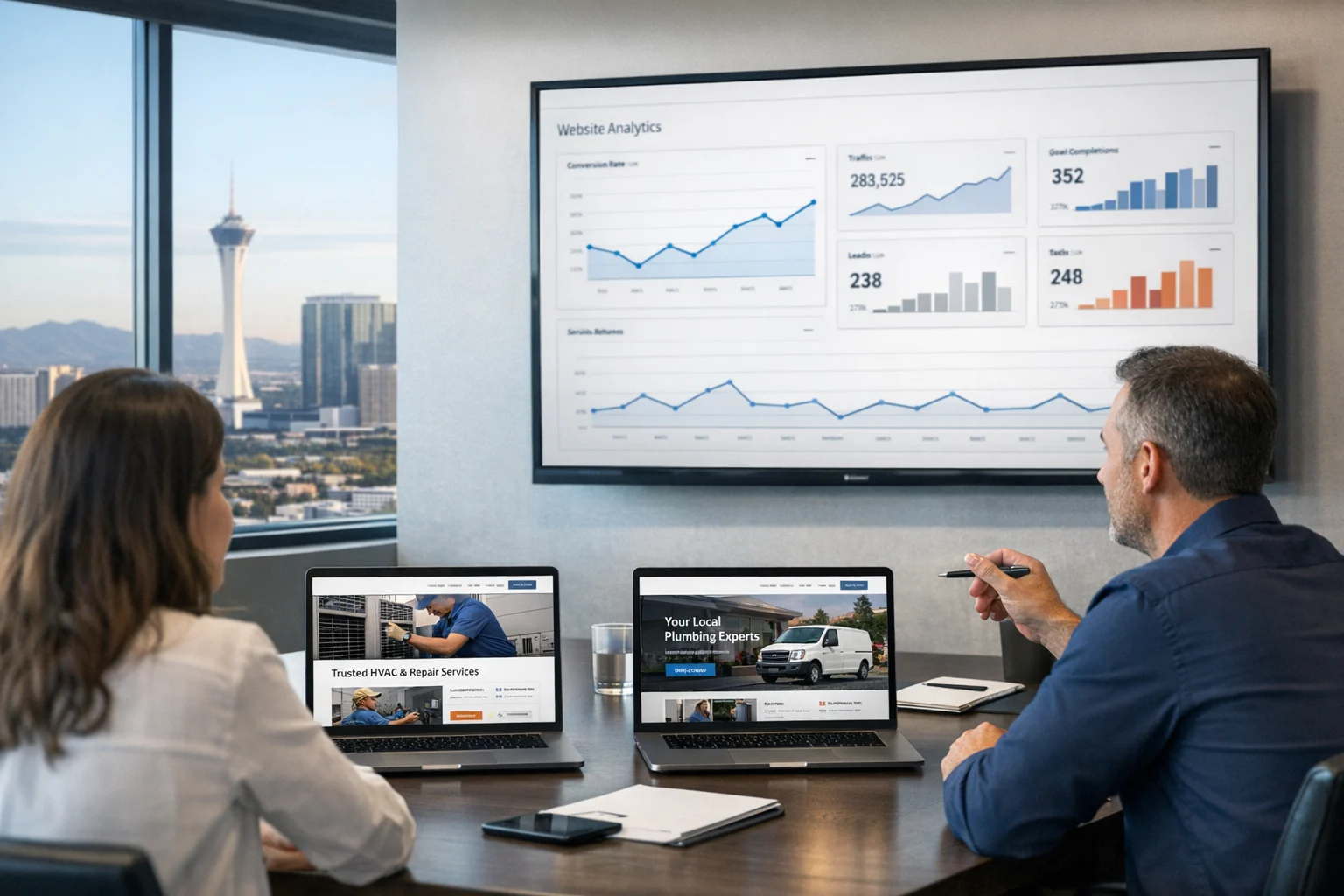
Local visibility used to be a fairly narrow game. Rank your website, keep your name and address consistent, collect reviews, and show up in the map pack often enough to stay in the conversation. That playbook still matters, but it no longer explains why one business keeps gaining ground while another with a decent site and solid reputation quietly slips.
What has changed is the number of signals search engines and customers now weigh at the same time. In competitive industries, local visibility is no longer just about appearing in search. It's about showing trust, speed, authority, location relevance, and operational credibility across multiple touchpoints before a prospect ever fills out a form or picks up the phone.
At SiteLiftMedia, we've seen this shift play out across home services, professional services, medical practices, hospitality, legal marketing, and multi-location brands. We work nationwide, but the trend is especially clear in Nevada. Las Vegas businesses are competing in one of the fastest-moving local search environments in the country, where search intent shifts quickly, competition is aggressive, and buyers compare options fast. If you're investing in Las Vegas SEO, web design Las Vegas services, or broader digital growth, the old idea of local visibility is already out of date.
Local visibility now happens across more than one search result
Businesses used to focus heavily on a single organic ranking or the three-pack. Today, searchers see a much more layered results page. Google Business Profile listings, paid ads, service ads, review snippets, AI-generated search features, location pages, video results, social profiles, and brand mentions can all influence who gets the click.
That means visibility is now fragmented. You can rank reasonably well and still lose leads if your Google Business Profile looks neglected, your landing page loads slowly, your reviews feel stale, or your competitors answer the searcher's question more clearly. In crowded markets, buyers are not just looking for whoever appears first. They're scanning for whoever feels safest, most relevant, and easiest to contact.
That is why local SEO Las Vegas campaigns have become more nuanced. It's not enough to chase rankings without fixing the page experience, conversion path, or trust layer behind the click. The businesses winning now are usually the ones aligning local search, website performance, reputation, and technical reliability into one system.
Competitive industries are feeling the pressure first
The shift is most obvious in industries where a single lead can be worth hundreds or thousands of dollars. Think personal injury attorneys, dentists, med spas, HVAC companies, roofers, plumbers, high-end contractors, and specialty medical providers. These markets are crowded, paid ads are expensive, and buyers usually compare multiple businesses before taking action.
In that environment, local visibility isn't just about being found. It's about being chosen. A searcher looking for emergency plumbing in Summerlin, cosmetic dentistry in Henderson, or a trusted med spa in Las Vegas is making a quick judgment call. If your competitor has stronger reviews, cleaner service pages, better mobile usability, and a stronger local footprint, that click goes elsewhere even if you technically appear on the same page.
We've seen B2B companies run into the same issue. A firm may offer excellent service nationwide, but if its local market presence is weak, it loses out to companies that look more established regionally. That applies whether the business is selling consulting, managed IT, commercial construction, or specialized professional services.
Google Business Profile has become a decision page, not just a listing
For many local searches, a prospect interacts with your Google Business Profile before ever visiting your website. They read reviews, check services, view photos, compare hours, scan questions and answers, and decide whether you're active enough to trust. In competitive industries, that profile often acts like a mini homepage.
Businesses that treat it as a set-it-and-forget-it asset are falling behind. Categories, service descriptions, review responses, recent photos, booking options, and update frequency all shape how complete and trustworthy the business appears. In some cases, even a strong website can't offset a weak local listing.
There's another layer to this. Google is getting better at understanding whether your business profile aligns with your website, local mentions, and market relevance. If the profile says one thing, your location pages say another, and your citations are inconsistent, the trust signal weakens. That's one reason local visibility feels more volatile than it used to.
We covered some of that shift in our article on the future of Google Business Profile and local search, and it's becoming a central issue for companies in competitive metros.
Your website now has to prove local relevance quickly
Once a prospect lands on your site, the old standard of simply having a decent-looking homepage is not enough. Search engines want clear service relevance, location signals, technical clarity, and a strong user experience. Users want speed, trust, and immediate answers.
This is where custom web design and technical SEO are closely connected. A site can look polished and still underperform because the structure is weak, service pages are thin, the mobile experience is frustrating, or the calls to action are buried. In highly competitive local markets, those weaknesses get expensive fast.
For businesses targeting Las Vegas and surrounding areas, the site has to do more than mention the city a few times. It needs useful service pages, relevant location content, strong internal structure, local proof points, and clear conversion paths. If you're trying to rank for phrases like Las Vegas SEO, SEO company Las Vegas, or web design Las Vegas, your site has to show why you're a real local option with real expertise, not just a national brand dropping city names into template pages.
That doesn't mean bloated content or spammy city-page tactics. It means building pages that actually help the visitor make a decision. Show the work, explain the process, answer common objections, and make contacting the business easy on every device.
This is one reason performance-focused design is becoming such a strong competitive advantage. We explored that in how performance driven design is changing business websites. When a site is built around speed, clarity, and conversion, local traffic turns into more qualified leads.
Authority is becoming broader than backlinks alone
Backlinks still matter. Strong backlink building services can absolutely improve search visibility when the links are relevant, earned, and tied to real authority. But in competitive local markets, authority now shows up through a wider mix of signals.
Search engines are watching for consistent brand mentions, local citations, industry recognition, topical depth, review quality, and how often your business is associated with the services you claim to offer. A business that earns mentions from local news outlets, chambers of commerce, trade organizations, event sponsorships, community pages, and respected industry sites often builds stronger long-term authority than a business chasing volume alone.
Content also carries more weight than it used to, especially when it answers specific questions buyers ask before converting. A contractor that publishes thoughtful pages on timelines, permits, warranty expectations, and common project mistakes can build a stronger local reputation than a competitor relying only on short service blurbs. The same goes for law firms, clinics, and agencies.
We've seen that search behavior shift firsthand, which is why local campaigns benefit from content expansion instead of just rank tracking. Businesses that publish useful, regionally relevant content tend to hold visibility better when markets tighten or result pages change. Our article on what changing search behavior means for local SEO campaigns goes deeper into that pattern.
Las Vegas changes the playbook
Las Vegas deserves special attention because local visibility works differently here than it does in slower, more stable markets. Search demand is intense, buying cycles can be short, and user intent isn't always purely local in the traditional sense. Some searchers are residents. Some are visitors. Some are planning ahead from out of state. Others need immediate service within the hour.
That creates a more complex search landscape. A business may need to rank for city terms, neighborhood terms, service-area phrases, and intent-based modifiers all at once. A home service company might care about Las Vegas, Henderson, Paradise, Summerlin, and North Las Vegas. A hospitality or medical brand may also need to speak to travelers or part-time residents. The competition gets even tighter when ads, maps, and organic results are all crowded with well-funded players.
For that reason, Las Vegas SEO tends to reward businesses that look complete from every angle. Strong reviews. Fast pages. Clear service coverage. Good media. Local content. Clean technical SEO. Reliable lead routing. Real proof that the business can serve the market well.
We've also noticed that seasonality matters more in Vegas than many owners expect. Spring marketing pushes, redesign planning before peak summer demand, and infrastructure cleanup ahead of busy periods can make a measurable difference. Businesses that wait until lead flow drops are usually reacting too late.
If you're trying to understand why search visibility feels different in Southern Nevada right now, our piece on what changing search behavior means for Las Vegas SEO provides a useful local lens.
Visibility is now tied to infrastructure, security, and reliability
This is the part many companies miss. Local visibility is not just a marketing issue anymore. In competitive industries, it is also an operations issue.
If your site loads slowly because the server stack is neglected, your forms fail because plugins are outdated, or your site gets flagged after a security issue, your local presence takes a hit. Rankings can slip. Users bounce. Leads disappear. Trust drops immediately.
That's why technical SEO has to be supported by real infrastructure discipline. Website maintenance, system administration, server hardening, and business website security are no longer side topics for large enterprises only. They're practical growth factors for any company that depends on inbound search.
We've worked with businesses that spent heavily on marketing while ignoring the stack underneath the site. Traffic improved, but conversions stalled because the booking tool was broken on mobile, SSL issues appeared, page speed tanked under load, or suspicious activity damaged performance. In a competitive local market, those failures are expensive.
Cybersecurity services and penetration testing also matter more than many business owners realize. A hacked site, malware warning, or data exposure event can damage local reputation and lead flow far beyond the immediate technical fix. Search visibility depends on trust, and trust is fragile.
That cross-functional view is one reason companies work with SiteLiftMedia. We don't treat SEO, custom web design, website maintenance, and infrastructure as separate conversations when the customer experience depends on all of them working together.
Social proof and brand presence now shape local search performance
Even when social signals are not direct ranking factors in a simple sense, they still influence visibility outcomes. Searchers look for consistency. They may find your site through Google, then check Instagram, Facebook, LinkedIn, YouTube, or review platforms before contacting you. If those channels look abandoned, the brand feels less credible.
In competitive industries, social media marketing can support local visibility by reinforcing expertise, showing current activity, highlighting recent work, and generating brand searches. That last point matters. Branded search behavior often increases when people encounter your business repeatedly across channels. Search engines tend to reward brands that users seem to seek out intentionally.
For local businesses, this means your online presence should feel connected. Your Google profile, service pages, review strategy, blog content, and social content should not tell conflicting stories. Businesses that look organized and current tend to earn more trust before the sales conversation even begins.
What winning businesses are doing right now
The companies gaining local traction in crowded markets usually are not doing one magical thing. They're making a series of disciplined improvements across search, design, content, and infrastructure.
- Refreshing core location assets by improving Google Business Profile categories, services, photos, review response habits, and contact accuracy.
- Expanding service and city content so their websites address real search intent instead of relying on thin, repetitive pages.
- Investing in custom web design that supports conversion, especially on mobile, where many local searches end in a call or quick form submission.
- Strengthening authority through smart backlink building services, local partnerships, digital PR, and industry mentions that actually fit the brand.
- Fixing technical SEO issues such as crawl waste, indexing gaps, page speed problems, broken schema, and weak internal linking.
- Cleaning up infrastructure with reliable hosting, website maintenance, system administration, and server hardening to protect uptime and performance.
- Taking security seriously through cybersecurity services, business website security reviews, and penetration testing where risk and traffic levels justify it.
- Aligning channels so SEO, paid traffic, and social media marketing support the same service priorities and local markets.
In practice, this often starts with a hard look at what's underperforming. Sometimes the issue is content depth. Sometimes it's design. Sometimes the site doesn't feel trustworthy. Sometimes the brand has good rankings but weak lead quality because the page content attracts broad searches instead of buyer intent.
What decision makers should measure instead of vanity metrics
One reason local visibility feels harder to manage is that many reporting dashboards still overemphasize the wrong numbers. A ranking report by itself doesn't tell you whether your business is actually becoming more visible where it matters most.
Better measures include growth in local organic traffic by city and service line, Google Business Profile actions, call quality, form completion rate, lead-to-sale rate, review velocity, branded search growth, and performance by high-intent pages. If a page ranks but never converts, it may not be a visibility win at all.
For Las Vegas campaigns, we also like to look at demand shifts by neighborhood, device behavior, and seasonality. Businesses are often surprised by how different the user journey can be between mobile searchers in an urgent situation and desktop users doing longer comparison research.
If you're evaluating whether to bring in outside help, ask whether the agency can connect rankings to real business outcomes. A strong SEO company Las Vegas businesses can trust should be able to talk about site performance, local search behavior, lead quality, technical health, and brand credibility in the same conversation.
Where to start if local visibility has stalled
If your traffic has plateaued, map pack visibility is inconsistent, or lead quality feels weaker than it should, start with a practical audit across four areas: your Google Business Profile, your highest-value service pages, your technical stack, and your trust signals. Most local visibility problems become obvious once those areas are reviewed together.
Look for missing service detail, weak calls to action, slow mobile performance, thin local relevance, low review activity, poor internal linking, outdated plugins, and inconsistent business information. Then prioritize fixes based on revenue impact, not just SEO neatness.
For many businesses, the smartest next move is not a full rebuild on day one. It's a focused roadmap. Tighten the technical foundation. Improve the highest-intent pages. Strengthen the local trust layer. Expand content where buyers need more confidence. Then support it with the right mix of SEO, design, and infrastructure work.
If you want a clear picture of what's helping or hurting your local visibility, SiteLiftMedia can audit your search presence, website, and technical foundation for Las Vegas or nationwide campaigns, then map out the next steps based on the markets and services that matter most to your business. Contact our team to get a practical plan in motion.
Photo Gallery